
Paw & Memory Journal · welcoming a new chapter while holding an old story
A New Chapter, With Room for the Old Story
A new chapter can have room for familiar photographs, well-worn keepsakes, and the particular character of a companion. What came before need not disappear for something new to belong.
7 August 2026
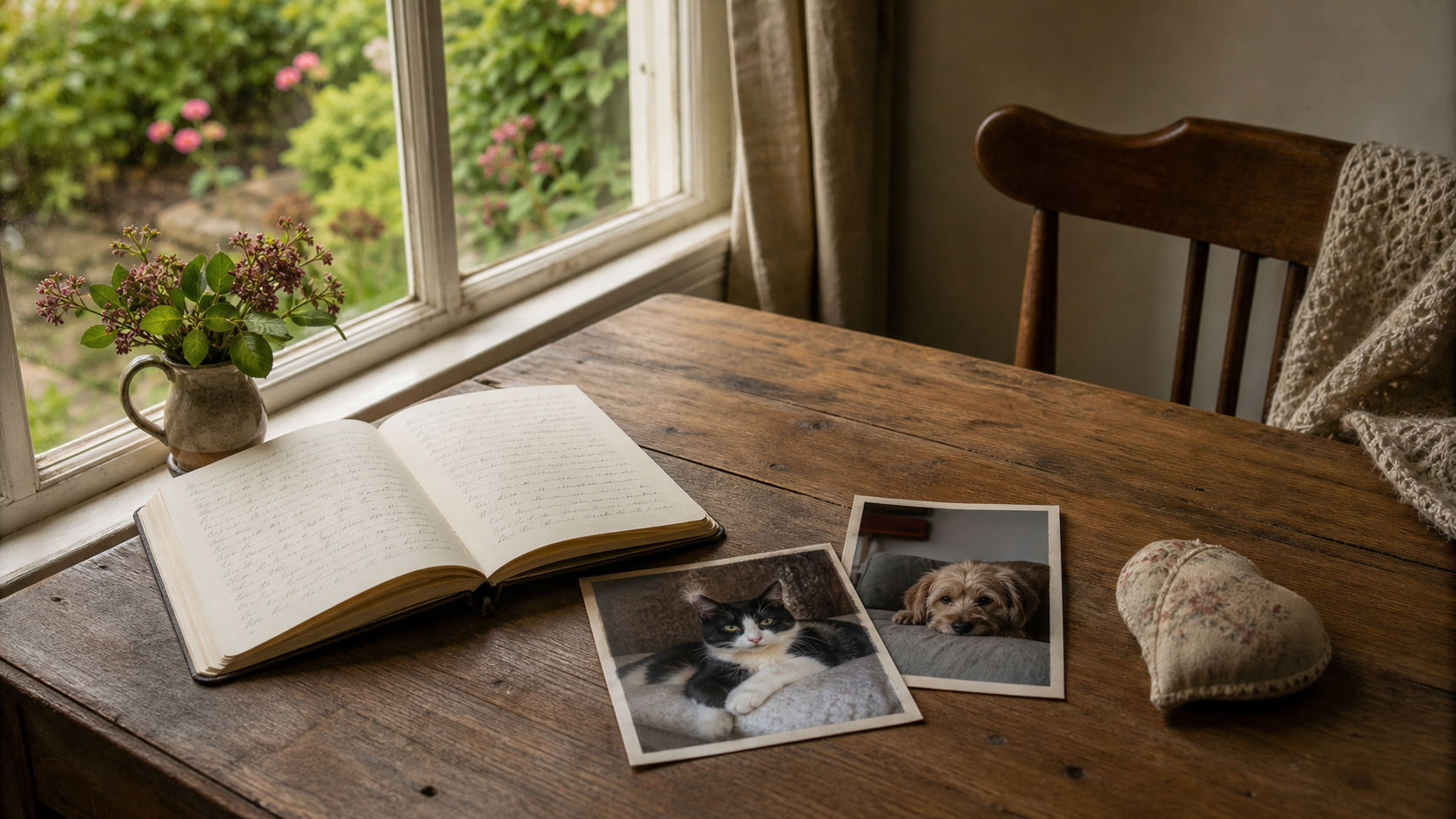
The old story and the new chapter do not have to compete for the same page. A photograph can belong beside a recent one. A remembered habit can sit alongside a habit still being discovered. There is room for what happened, what is happening, and what has not yet found its words.
A new chapter rarely announces itself with a clean page. More often, it arrives while an old photograph is still on the shelf, while a familiar name still comes easily to the tongue, while the corner of a blanket holds the shape of years. It might be a new home, a new companion, or simply a new season with the animal already beside you. The change can be real without making the earlier story less real. What does this chapter seem to be asking for a place beside? Perhaps the answer is not a grand memory, but a small one: a head at the window, a paw across a shoe, the sound of someone settling nearby. The old story often lives in things that would look unremarkable to anyone else.
A photograph with poor light. A lead with a faded patch. A scrap of paper carrying a name in hurried handwriting. Their meaning is not in how well they present themselves, but in what they bring to mind. There was a particular afternoon behind that picture, a particular doorway beyond that lead. Even the blurred edge may belong to the story, because the subject had somewhere else to be. Which detail still feels unmistakably theirs? The answer might be a crooked ear, a serious gaze, or the way they appeared in family photographs as though the gathering had been arranged around them. Sometimes the new chapter includes another animal, with another face at the window and another way of being in the room.
Sometimes it includes the same companion, now part of a different household rhythm. Either way, comparison may enter the story before anyone has invited it. One loved the sunny patch; another seems to prefer the spot beside the chair. One appeared in every photograph; another is mostly a departing tail. These differences can be part of the account without becoming a ranking. What belongs only to this companion, in this moment? There is something quietly wonderful about a small animal taking up an entire sofa and leaving a person the courtesy of one narrow edge. A photograph can hold two times at once: the moment it shows and the moment in which it is being looked at.
The room in the picture may no longer be the room around you. The person behind the camera may remember more now than they understood then. A companion who has died may still appear there in the middle of an utterly ordinary day, looking toward something just outside the frame. Beside that image, a recent photograph may carry its own unfinished account. What connects the two pictures? It could be the same chair, the same garden, or the familiar wish to catch an expression before it changes. Neither picture needs to explain away the other. Not every part of an old story has to become an object on display. Some parts remain in the telling: the account of a rainy afternoon, the pause before a familiar name, the remembered weight of a head resting on a knee.
Other parts are still being made, even in a household that feels well known. There may be a photograph from last week that has not yet become a favorite, or an ordinary morning whose meaning will arrive later. Which moments seem small now but might become part of the family story? Remembrance and celebration can share this attention to particulars, whether the companion is present in the room or present in what someone remembers. Welcoming a new chapter can be less like closing a book than noticing that the story has another setting. The old pages still contain their own weather, their own rooms, their own beloved character. The newer pages may feel sparse for a while, with details that have not gathered much history yet.
What feels familiar here, and what feels entirely new? Both answers can belong. There is no need for a final sentence that makes every part fit neatly together. A family story may hold a remembered companion, a companion nearby, and a future still without photographs. For now, perhaps its truest shape is this: an old picture on the shelf, and room beside it. title holder
A place for their story
Remember a life, one link at a time.
Explore Paw & Memory at the address below, or scan the QR code to open the memorial starting point in your browser.
Explore memorials Scan or visitpawmemory.live/