
Paw & Memory Journal · letters and the words we keep
Letters and the Words We Keep
A letter can hold a nickname, a small scene, or the words that never quite found their moment. What would yours say about the companion you remember, or the one sharing an ordinary day with you?
3 July 2026
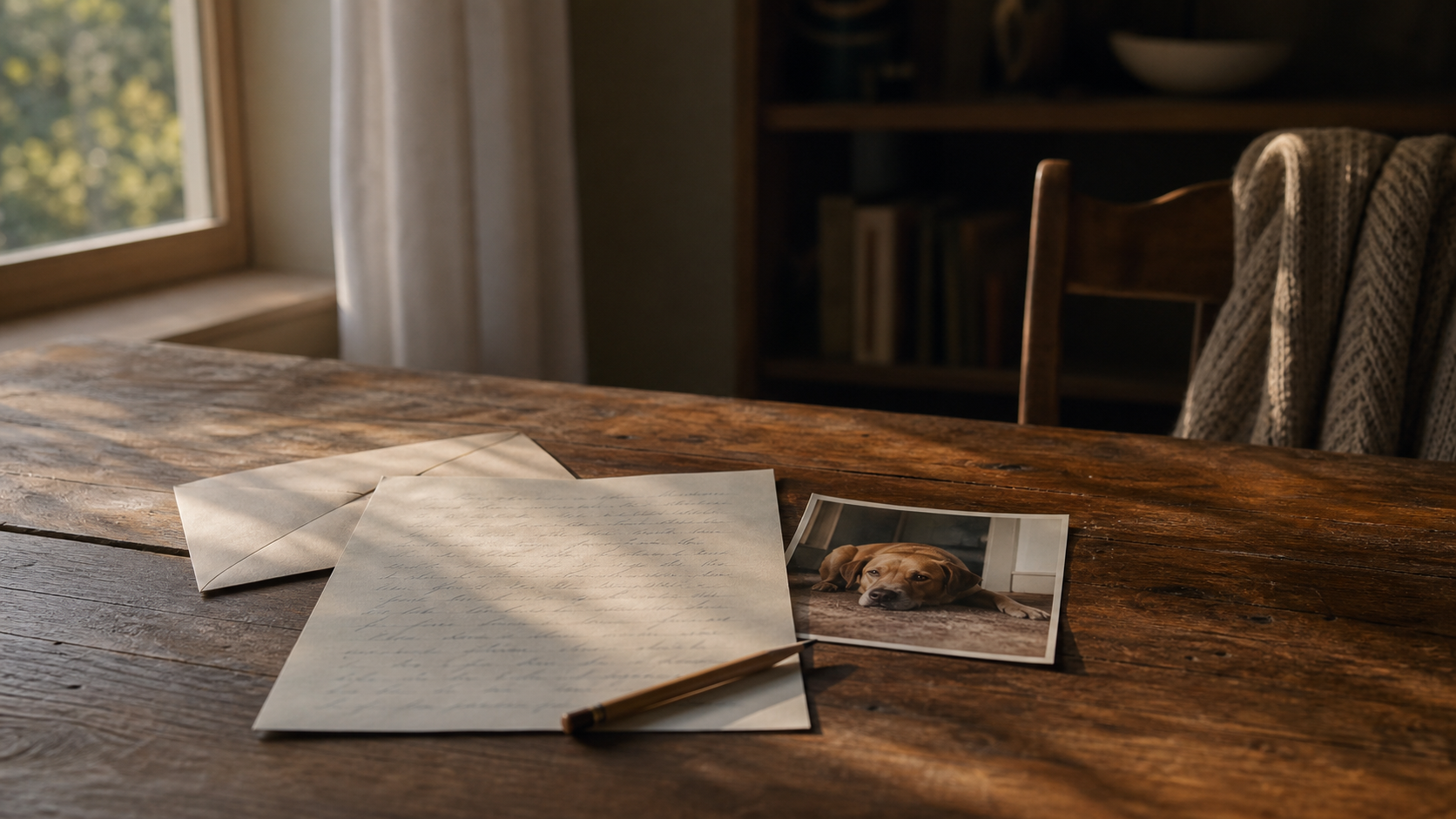
Not every letter needs a grand beginning. Sometimes the words worth keeping are a nickname, a familiar greeting, or a few lines about the way a companion made an ordinary room feel like somewhere you belonged together.
A letter to a companion might begin with the name you almost never used outside the house. Not the name on a form, but the one that grew out of a sleepy face, a particular sound, or an incident involving the good chair. Dear Little Bean. Dear Old Friend. Dear You. Already, the page has something of your shared life in it. There is no need for a grand opening in this imagined conversation. What greeting sounds most like your voice when you came through the door? What would follow if you were not trying to explain your companion to anyone else, but simply speaking to the one who knew the sound of you? Some of the words we keep are hardly sentences at all.
A caption beneath a photograph. A name penciled on the back of an envelope. A message that says, Look who has your spot. These scraps can be full of the small details a longer account might pass by: the hour of the day, the patch of light, the blanket with one corner folded under. A cat, of course, may consider a letter most useful when it is available to sit on. What ordinary phrase belongs to your household’s particular language? Was there a greeting, a fond title, or a running comment that made perfect sense to everyone who shared the room? For someone remembering a companion, a letter may have an absent reader and a very familiar voice.
Its subject does not have to be the last day or the largest feeling. There might be a whole paragraph about the place beside the bookcase, or the sound of paws crossing a floor while the kettle was on. There might be a line about something you still expect to see when you glance toward a doorway. What would you tell them about an ordinary afternoon you shared? Which small scene would you choose if the page had room for only one? A letter can stay close to what happened, without having to explain what that moment means to anyone else. For someone whose companion is nearby, the letter may belong entirely to the present tense.
You are asleep in the next room. Your ear is folded in that familiar way. The afternoon has gone quiet, and here we are. Words about an ordinary day need not borrow the language of farewell. They can notice a character still being revealed through years of shared rooms and familiar scenes. What detail seems especially theirs today? Which photograph would sit beside these lines, and what would the photograph leave out? Perhaps the picture shows a face in the window, while the words hold the sound of someone in the house saying their name, just before the shutter clicked. There are also words other people give us: a note tucked into a card, a remembered remark, a message from someone who noticed the same dear quirk.
Sometimes their version of a companion includes a detail we missed. They remember the welcome at the door; we remember the pause on the landing. Neither account has to become the official story. What words from another person would you place beside your own? Is there a phrase that sounds exactly like the person who wrote it? The handwriting, a crossed-out word, or an uneven line can be part of what the letter holds. It carries traces of the writer as well as a glimpse of the companion they knew. A page might end with love, with a nickname, or with a sentence that feels unfinished because there is still more to say. It might remain a few lines rather than become a full account.
Not every shared life fits neatly into a beginning, a middle, and an ending; so much of it happened between other things, beside a chair or under a table. What words feel like yours, rather than words you think a letter ought to contain? What would your closing sound like if it were spoken softly across the room? Among photographs and keepsakes, a letter offers its own kind of detail: the particular words one person chose for one particular companion, on one particular day.
A place for their story
Remember a life, one link at a time.
Explore Paw & Memory at the address below, or scan the QR code to open the memorial starting point in your browser.
Explore memorials Scan or visitpawmemory.live/