
Paw & Memory Journal · letters and the words we keep
Letters and the Words We Keep
A name on an envelope, a phrase beside a photograph, a letter with no address: the words we keep can hold the small, particular details of a life shared with an animal.
22 July 2026
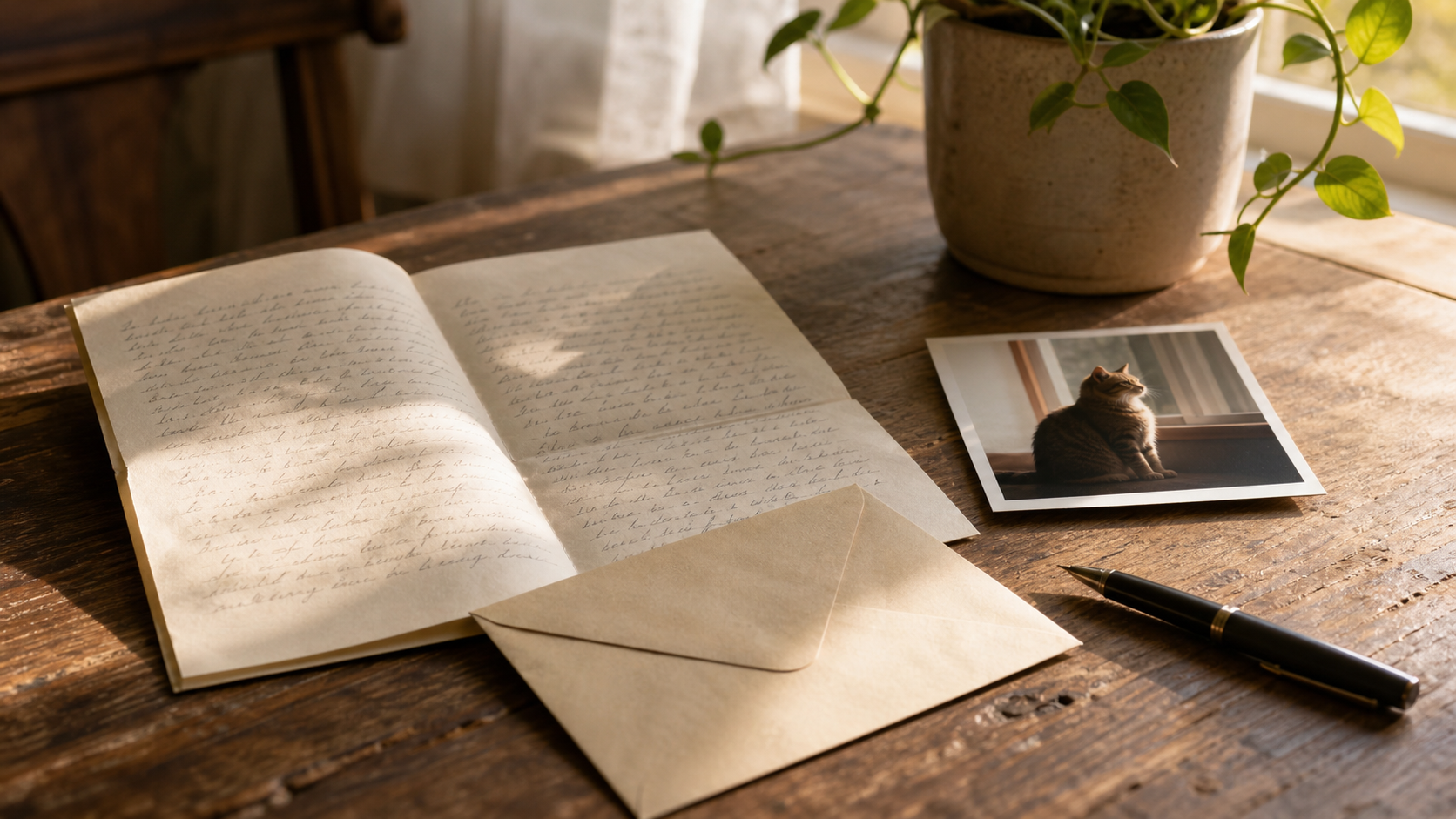
Some words belong to a whole household, though only one member ever said them aloud. A nickname, a greeting at the door, a note beside a photograph: each carries something of the companion who made it familiar. Letters offer room for those ordinary words, whether we are remembering a life together or noticing the life beside us now.
Some words belong to a whole household, though only one member ever said them aloud. There is the greeting at the door, the name stretched into an extra syllable, the phrase attached to a certain look across the room. On paper, these may seem too small to count as a letter. Yet a letter need not begin with grand news. It might begin with, “You always chose that patch of light,” or, “I never did find a shorter name that suited you.” What words sound most like the life you share, or shared, with your companion? Which ones would a visitor never know, but someone who lived there would recognize before reaching the end of the sentence? A letter addressed to an animal has a particular freedom: there is no need to explain the household from the beginning.
The blue chair can simply be the blue chair. That corner of the rug needs no map. A familiar window can appear without a description of the street beyond it. Whether your companion is beside you now or present in memory, the page can hold this private vocabulary of places and moments. What would you say if you could assume that every room, sound, and small event was already known? Perhaps the opening is less a formal “Dear” than the start of a conversation that has been going on for years, in words and in their absence. Then there are the words kept beside pictures: a date, a place, a line that explains why this blurred photograph matters. “The afternoon you sat with us” says something different from “Summer at home.” Neither needs to tell the whole story.
A few words might name what the camera missed: the conversation just outside the frame, the light moving across the floor, the fact that everyone had settled there without planning to. Which photograph holds a moment you would like to describe in a letter? What happened just before it, or after? The image offers one small rectangle of time; the words have room for the rest of the room, including whoever was holding the camera that day. For a companion whose life you are remembering, a letter might contain things that never seemed worth announcing at the time. The spot beside the desk. The sound of paws crossing a familiar floor. The name you used when nobody else was there.
There may be words you still use in conversation, and others that now belong mostly to the page. What ordinary moment would you want this letter to know about? What detail feels unmistakably theirs, even if it would mean little to anyone outside your home? There is room here for affection without a polished account of every year, and for a memory that remains unfinished at the edges, like a photograph whose background has gone soft. For a companion whose everyday character is unfolding beside you, the letter may be full of present tense. You are here. You have claimed that particular seat. You are part of an afternoon that might otherwise pass without a name. A cat inspecting an envelope may also consider the entire correspondence to be a very modest proposal for a new place to sit.
Beyond that small interruption, what would today’s letter notice? Which detail feels so familiar that it is easy to leave unmentioned? A letter can dwell on a single scene without turning it into an occasion: a shared room, a head near your hand, the quiet fact of being in the same place while the day goes on. The words we keep do not all have to agree in tone. One letter may be tender, another full of plain details, another no more than a fragment tucked beside a picture. A nickname might outlast the explanation of how it began; a longer note might preserve the whole unlikely history. What phrase would you recognize as yours even without a signature?
What would you want a future reader to understand about this particular companion, rather than animals in general? Somewhere between the greeting and the last line, there is space for a life as it was known at home. Not only the milestones, but the chair, the window, the name, and the ordinary words that gathered around them.
A place for their story
Remember a life, one link at a time.
Explore Paw & Memory at the address below, or scan the QR code to open the memorial starting point in your browser.
Explore memorials Scan or visitpawmemory.live/