
Paw & Memory Journal · Letters, remembered phrases, and the everyday language of the human–animal bond
Letters and the Words We Keep
A name in the margin, a familiar phrase, a letter with no need for an answer: the words we keep can hold both an ordinary afternoon and the memory of a much-loved companion.
3 August 2026
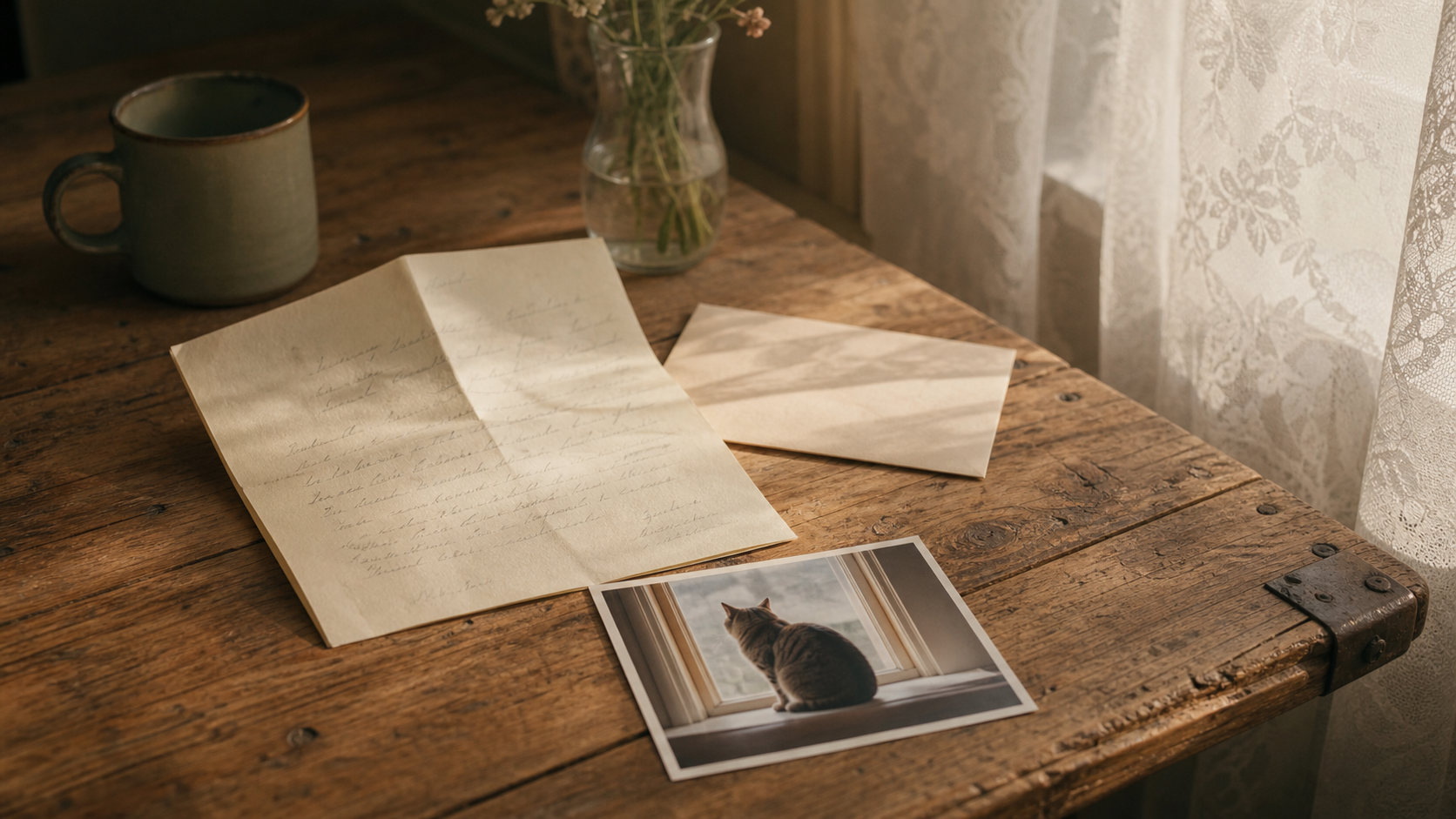
Not every letter needs a grand beginning. Sometimes the truest opening is a small detail: the chair they chose, the sound of their name, the expression that made the whole family laugh. There is room on the page for companions beside us now and those we remember.
There are words we keep because someone wrote them, and words we keep because we said them so often they became part of the house. A companion’s name may belong to both: ink on an old envelope, a greeting at the door, a soft question asked across a room. A letter can begin there, without a grand opening or a neat account of a whole life. “You always chose that chair” might be enough. So might “I still call this your window.” What small phrase belongs to your shared days, and what does it bring into view? Perhaps not a milestone, but an afternoon with nothing special on the calendar and someone very special in the room.
The words that feel most yours may be wonderfully plain. There was the nickname nobody outside the family quite understood, the running commentary about the weather, the elaborate title bestowed on an animal who owned neither land nor office. A cat can be addressed as a distinguished guest while sitting squarely on the letter meant for that guest. Such details have room in a letter alongside the tender ones. Which names came first, and which arrived later? Was there a phrase that everyone borrowed? The answer might include a scrap of family language, a sentence with an odd rhythm, or a word that only made sense when spoken toward a particular pair of ears. For someone remembering a companion, a letter might move between then and now without asking either tense to do all the work.
“You used to wait here” can sit beside “I noticed the light on the floor today.” Neither sentence has to explain the other. There may be a story you have told many times, and another so small it has never seemed like a story at all: a nose appearing beside a book, a paw resting on the edge of a blanket, the familiar shape in a doorway. Which scene would you describe if there were no need to make it important? A letter has space for an ordinary moment, just as it was. For someone sharing life with a companion now, the letter may be full of present tense. You are the one who appears in every photograph as a blur.
You have a solemn face and a thoroughly unserious place in our family stories. You were beside the table while we talked about things that had nothing to do with you, although your portrait somehow became the main subject. What would a letter say about this particular season of your days together? There is no need for a prediction or a summary. The page might hold the name of a room, a description of a look, or the exact words someone said before the whole household laughed. Sometimes the words are already waiting among photographs and keepsakes. A date on the back of a print. A note tucked into an album. A caption that says only “our usual spot,” as if that could explain everything.
Beside the image, it may explain quite a lot: whose knee is just outside the frame, why the cushion is crooked, what was happening a second before the shutter clicked. What words would sit beside a photograph you know almost by heart? They might tell the part the camera missed. They might also admit what you cannot quite recall. A letter need not pretend to remember every detail to speak fondly of the ones that remain. Then there are the endings, which do not always feel like endings. A letter might close with the old nickname, a thank-you for one small afternoon, or a sentence that sounds exactly like the person writing it. It can be funny in one line and tender in the next, with no obligation to settle into a single mood.
What would you want the last few words to sound like: the voice at the door, the voice beside the window, the voice telling a favorite story once more? Somewhere between a formal farewell and a cheerful hello is the language of your own bond. Perhaps the final line is simply the name you have said so many times.
A place for their story
Remember a life, one link at a time.
Explore Paw & Memory at the address below, or scan the QR code to open the memorial starting point in your browser.
Explore memorials Scan or visitpawmemory.live/