
Paw & Memory Journal · letters and the words we keep
Letters and the Words We Keep
The nicknames, small stories and unfinished sentences that belong to life with a companion.
28 August 2026
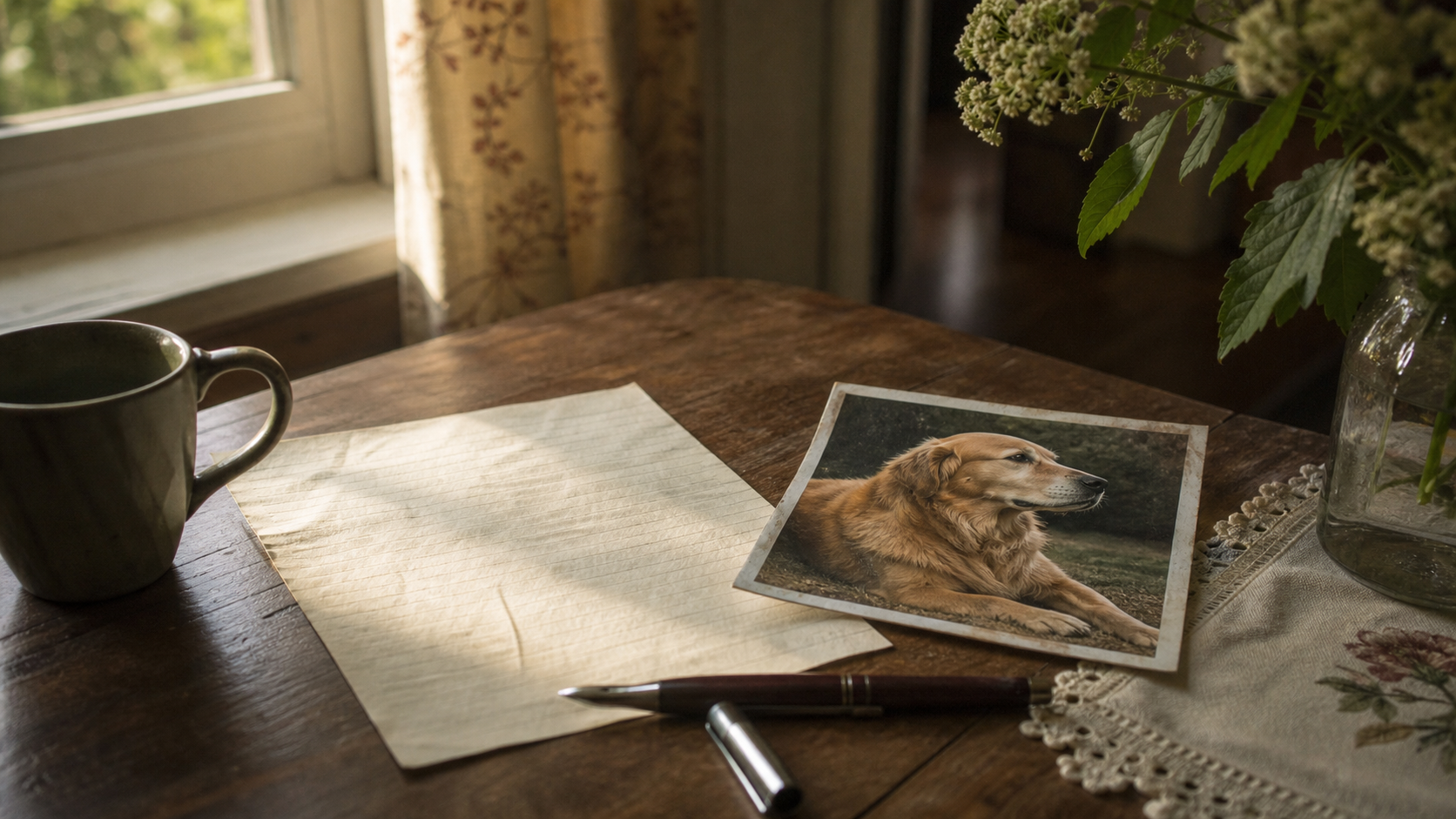
A letter to a companion does not need a grand occasion. Sometimes its whole subject is the sound of paws crossing a room, or the particular way a familiar face appeared beside the table.
Some words belong to a household before they belong to a dictionary. There is the proper name, of course, but also the name that grew an extra syllable, the greeting reserved for a familiar face at the door, the little sentence spoken whenever someone occupied the good chair. Written down, these words can look almost surprisingly ordinary. On the page, there is no voice stretching a vowel, no answering glance, no soft interruption of paws crossing the room. Yet a letter has room for those details too. Whether the companion you are writing about is beside you now or belongs to a chapter you remember, the opening might be the same: Dear you. What words would make that particular you unmistakable, even before a name appeared?
A letter need not concern the largest day in a shared life. Its whole subject might be a Tuesday, a photograph slightly out of focus, or the way a companion looked when the household finally settled in the evening. There is something companionable about a sentence that admits, Nothing much happened, and then discovers that plenty did. A chin rested on a knee. A familiar shape filled the doorway. Someone turned three times before choosing the spot they had apparently intended all along. What would a letter about an unremarkable afternoon contain? Perhaps it would describe the light on a coat, the sound of a tag, or a small household pause. The ordinary details are not preliminary notes before the real story. They are much of the story.
Then there are the words already kept: a caption beneath a photograph, a note on the back of an envelope, a birthday greeting written in an animal’s supposed voice. Some families have a whole unofficial vocabulary tucked into messages and scraps of paper. A companion might be addressed as the assistant manager, although the duties seem to consist chiefly of sitting on the correspondence. That small joke can carry a very exact portrait: the serious expression, the inconvenient position, the confidence that this is plainly where the household’s attention belongs. Which nickname contains a scene rather than merely a name? Which repeated phrase still arrives in somebody’s familiar voice? A letter can hold both the joke and the tenderness underneath it, without explaining either until it becomes less itself.
For someone remembering a companion who has died, the tense of a letter may feel noticeable. You were, you are, I remember, I still say. Those phrases can sit beside one another without the page having to resolve them. A remembered moment happened in the past; the affection in the sentence belongs to the person writing now. There may be a photograph nearby whose edges have softened, or a keepsake whose meaning would be invisible to a stranger. What would you want to say about the moment behind that object? Not necessarily a farewell, and not necessarily a summary of an entire life. Perhaps only this: I remember the afternoon this picture was taken. Perhaps a letter pauses there, with a scene that needs no larger conclusion.
For someone celebrating a companion’s everyday character, a letter might sound more like an affectionate report from the middle of things. Today you watched the rain. Today you chose the folded blanket. Today your face appeared in the corner of another photograph that was supposedly about something else. The details are particular to this companion, in this household, on this day. What would you want a future reader to understand about the company you share now? What small preference, expression or familiar arrival would be missing from a description made only of age, color and name? A letter can be addressed to the companion while also speaking to the person you will be later, when the room, the photograph or the handwriting may look different.
Not every word worth keeping sounds polished. There may be an awkward opening, a crossed-out adjective, or a sentence that repeats itself because the first version did not quite say it. There may be very few words at all. Under a photograph, That was your spot can contain a room, a season and the memory of looking over to find someone there. A longer letter might wander through several years and finish with a nickname no visitor ever heard. What is the phrase that belongs most closely to your shared life? What would come after Dear you if there were no expectation of eloquence? The page might end with a story, a question or an ordinary household greeting—the kind spoken so often that it became part of being together.
A place for their story
Remember a life, one link at a time.
Explore Paw & Memory at the address below, or scan the QR code to open the memorial starting point in your browser.
Explore memorials Scan or visitpawmemory.live/