
Paw & Memory Journal · letters and the words we keep
Letters and the Words We Keep
Some letters are addressed to a companion. Others are tucked into the language of an ordinary day. A reflection on the nicknames, small stories and familiar phrases that hold a place in a pet family’s life.
16 September 2026
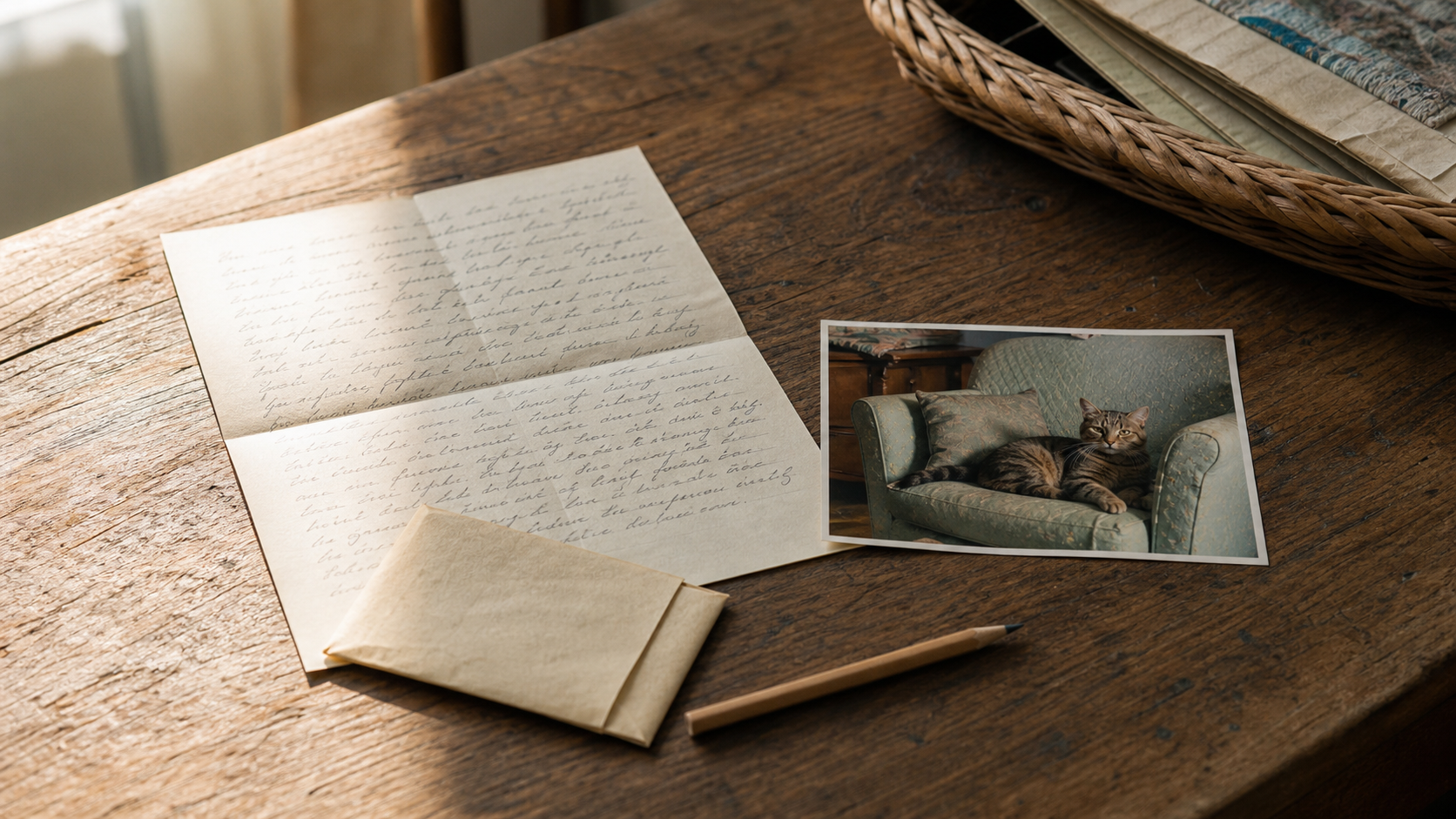
A companion’s story can live in a nickname, a note beside a photograph or a sentence that sounds like home. Letters leave room for the grand affection and the small details: the occupied chair, the sound at the door, the words spoken so often they became part of the day.
A letter to a companion can begin with a name, though perhaps not the name on any official piece of paper. It might begin with the soft, slightly ridiculous name used in the kitchen, or the longer one that appeared when the whole family joined in. Dear Little One. Dear Old Friend. Dear You. Even before the next sentence, there is a particular relationship on the page. What name would sound most like your shared life? Which greeting belongs to the companion beside you now, or the one you remember? A letter offers space for words that were spoken every day and words that never quite found their moment, without requiring them to sound grand. The details in such a letter might be very small: a pale hair caught in the weave of a dark cushion, the click of paws across one stretch of floor, a face visible between the rails of a chair.
These are not necessarily the moments that made it into photographs. They are the background of being together, noticed so often that they became familiar. Which ordinary scene would you recognize from only a few words? Perhaps it is the view from your usual seat, with one familiar shape in the corner. Perhaps it is an evening when nothing happened except that you were both there, while the light moved across the room and the house sounded like itself. Some of the words we keep were never intended as keepsakes. They were captions beneath a photograph, a message sent to someone in the family, or a note explaining why a picture was worth saving. Here she is again.
That is his spot. You should have seen this face. A cat occupying the only chair needed for writing can look remarkably like the chair of the correspondence committee. Beneath the small joke is an exact piece of household history: who sat where, what caught your eye, whom you wanted to tell. Which phrase in an old message still brings back the whole scene? What did your family say so often that it became almost another name? For someone remembering a companion, a letter may move between past and present without settling neatly into either. You were there in that photograph. I still call that corner your corner. The grammar follows the way a story is being told, and a single page can hold more than one kind of sentence.
There may be affection, an unfinished thought, a plain account of a Tuesday, or something that seems too slight to explain to anyone else. What would you want your companion to know about the place they had in your days? Which moment would you describe without making it larger or tidier than it was? Even a remembered pause can belong in the telling. For someone celebrating a companion’s everyday character, the letter might be full of things happening now. There is the particular angle of a sleeping ear, the outline of a nose in a window reflection, the familiar presence beside a pile of laundry. There are photographs still being taken and nicknames still changing. What would a letter dated in this season say about your shared days?
What detail feels unmistakably theirs, even if another family would barely notice it? A companion’s portrait in words need not resemble a formal tribute. It can sound like the way you speak across a room, with affection folded into an observation so ordinary that you almost forgot it was a story. Then there are the words kept around the letter: a date on the back of a photograph, a name written on an envelope, a sentence someone else remembered differently. Together they suggest the many voices inside a shared life. One person recalls the window; another recalls the patch of sunlight below it. Neither account has to contain everything. What words would you most like to find again among those scraps?
What small story would you hope someone in your family would recognize as soon as they read it? The closing might be as simple as the greeting: Love, us. Between those few words is room for the companion you knew, the one you know, and the ordinary days you shared.
A place for their story
Remember a life, one link at a time.
Explore Paw & Memory at the address below, or scan the QR code to open the memorial starting point in your browser.
Explore memorials Scan or visitpawmemory.live/