
Paw & Memory Journal · letters and the words we keep
Letters and the Words We Keep
Some letters are addressed to a companion. Others are written around them, in the margins of ordinary days. A reflection on familiar phrases, unfinished sentences, and the small details we choose to keep.
28 September 2026
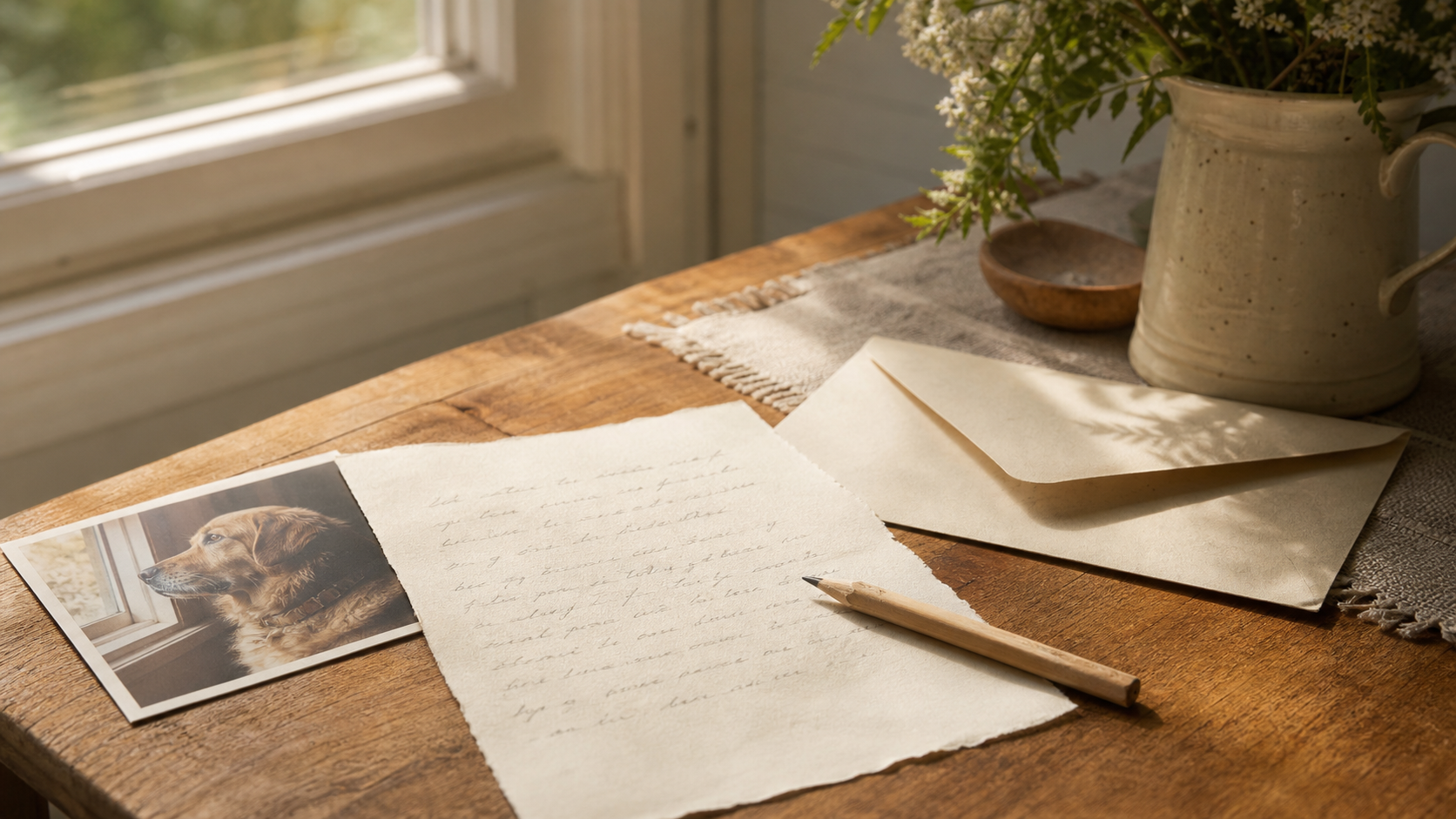
A letter to a companion does not need a grand beginning. It might start with the sound of paws in the hallway, a favorite patch of afternoon light, or a sentence your family has said so often it belongs to everyone. The words we keep can be as ordinary, and as particular, as the days we shared.
A letter to a companion might begin with a name, but it could just as easily begin with the weather: the rain against the kitchen window, the strip of sun across the floor, the afternoon when nothing much happened. There is no requirement for an important occasion in these imagined pages. A greeting can belong to a companion sleeping nearby or to one remembered through a photograph on the shelf. What would your first sentence notice? Perhaps it would be something you have said aloud a thousand times, now written with unfamiliar attention. Perhaps it would simply be, “You were there.” Or, for the companion currently occupying the room, “Here you are again, in your usual place.” The words a household keeps are not always the words anyone planned to remember.
They may be a nickname that wandered far from the original name, a greeting spoken at the door, or the phrase attached to one particular photograph. “That was your window” can contain a whole room: the curtain edge, the marks on the sill, the view everyone else passed without considering. Which everyday words belong especially to your companion? Which sound different when written down? A letter might hold the exact family wording, including its odd grammar and affectionate repetition. It need not sound like a formal tribute. It might sound like someone standing in the hallway, still wearing a coat, saying hello. Then there are the details that seem too small until a sentence gives them room.
The pale thread caught on a dark blanket. A whisker visible against the edge of a photograph. The particular angle of a head when someone entered the room. A letter might linger over any of these without needing to explain what they mean. What would you describe to someone who had never met your companion, and what would only your household recognize? There may be an entire paragraph in the corner of one ordinary picture. There may also be a companion who regards the paper itself as a reserved seat; your carefully chosen opening sentence has acquired a rather substantial paperweight. For someone remembering a companion, the letter may move between past and present without settling neatly into either.
“You loved this spot” can sit beside “I still look toward it.” For someone celebrating a companion’s everyday character, the same page might contain this morning’s small scene and a memory from years before. What belongs in the present tense of your letter? What arrives in the past? There is no need, within this imagined conversation, for every sentence to agree about time. A photograph already contains that curious mixture: an afternoon that ended, a face that remains visible, a detail being noticed now. The words beside it can acknowledge all three, without trying to make them one. Some letters are made partly of other people’s words. A family member remembers the companion at the back door; someone else remembers the shape left in a cushion.
A note tucked behind a photograph might say only where it was taken, while its handwriting brings another person into the scene. Whose phrases would belong in your letter, and which memory would you place beside them? These accounts need not match perfectly. One person may remember a quiet afternoon, another the interruption halfway through it. Together, they offer different views of the same shared life. Even a crossed-out word can belong to the page: evidence of someone pausing, searching for the description that sounds most like this particular companion. An ending can be modest. A letter might stop after a remembered morning, a thank-you, or a description of what is happening in the room today. It might remain unfinished beside an envelope, with the last line waiting for another ordinary detail.
What would you want the final sentence to hold: a name, a scene, a familiar phrase, or something you have never quite said aloud? Not every affection arrives as a declaration. Sometimes it appears in the accuracy of a small observation: this was the blanket, that was the window, here was your place beside us. The words we keep do not have to account for an entire life together. They can belong to one moment, lovingly noticed.
A place for their story
Remember a life, one link at a time.
Explore Paw & Memory at the address below, or scan the QR code to open the memorial starting point in your browser.
Explore memorials Scan or visitpawmemory.live/