
Paw & Memory Journal · A companion’s character and funny little habits
That Is So Like Them: A Companion’s Character in Little Habits
The grand parts of a companion’s story matter, but so do the small, odd details: a chosen chair, a solemn stare, a toy carried like important mail. Those little habits give everyday life its very particular company.
6 July 2026
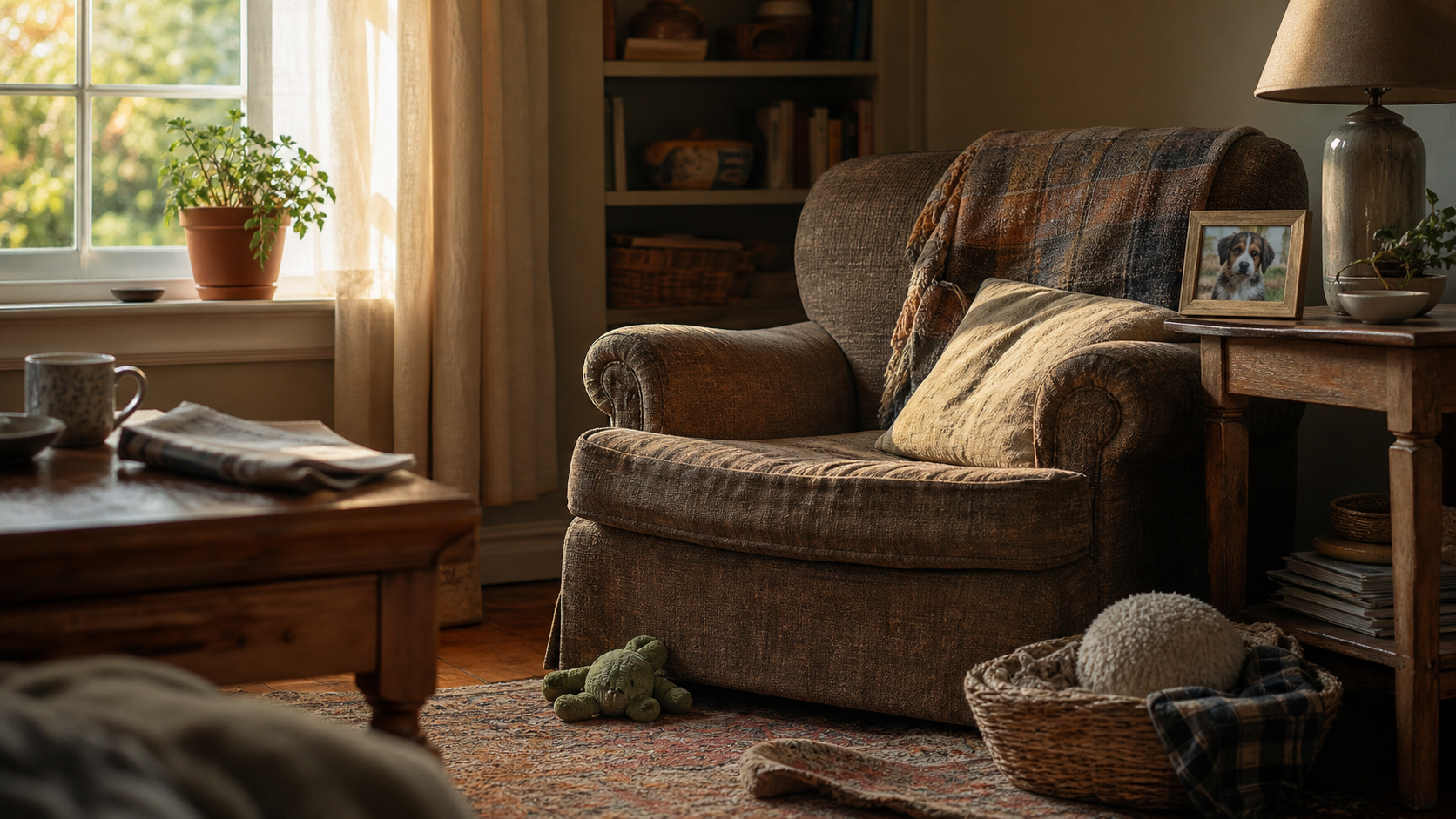
A companion’s character often lives in the smallest scenes: the pause at a doorway, the claim on a chair, the great fuss over one unremarkable toy. Whether these moments belong to today or to memory, they hold the shape of someone wonderfully specific.
A companion’s character can be hard to sum up, even when every member of the family knows it by heart. Sweet is true, perhaps, but it leaves out the way they stood in a doorway as if they owned both rooms. Playful is fair, but it misses their deep concern about a toy that had rolled just out of sight. The words that fit best may be the ones used at home: the boss, the little clown, the nosy one. Which small scene comes to mind before any grand word does? Often, a whole character seems to step into view through one very ordinary moment, complete with a look that needs no caption. Some habits come with a sense of occasion that the rest of the room does not quite share.
Perhaps a small scrap of cloth had to be carried from one place to the next, with all the grave purpose of an important letter. Perhaps a companion paused beside the same chair each day, waiting for an audience before making a grand entrance onto the seat. There is something quietly funny about a creature who can turn a cushion into an appointment. What object seemed to have a role in their private world? Was it prized, ignored, moved about, or watched with a puzzled stare? The answer may be less about the thing than its particular place in their story. Then there are the details a photograph almost catches. An ear sits at an odd angle.
A paw rests on the edge of a rug. The face is still, but someone who knows that face can supply the next part of the scene. A guest was about to arrive, perhaps, or a familiar voice had just come from the hall. The picture holds one second; the family remembers the bit before and the bit after. Which photograph looks most like them, rather than merely showing them clearly? It might not be the neat portrait. It might be the blurred turn of a head, with half the room in view and their whole character somehow present. The names for these little habits often become part of a household’s own language. A certain turn in the hall might be called the inspection.
A long look from the sofa might be the review. No one needs a full account each time; one word brings back the scene. In a family’s telling, a tiny event can acquire quite a cast: the companion, the visitor, the chair, the person who thought the chair was free. What phrase belonged to your shared days? Who first said it, and did it sound like a joke from the start? Such words can be fond without being grand. They belong to the scale of life as it was actually lived. For someone remembering a companion, a funny habit may sit beside a tender one without either needing to make way. The toy was ridiculous, and it was theirs.
The chair was just a chair, and the sight of it may bring back a very exact pose. For someone sharing a home with a companion now, those same small details may be unfolding in the next room. Neither kind of story has to be polished into a lesson. What did they do that felt entirely their own? What might another member of the family remember quite differently? A character can have more than one good telling, especially when the household’s chief witness was also the household’s chief mischief-maker. Perhaps the most fitting portrait is not a single image or a perfect sentence, but a handful of scenes that do not quite match. Bold at the window, shy of a new box.
Solemn with a toy, absurd on a cushion. A companion could be many things in one day, and wonderfully hard to reduce to a tidy description. Which contrast makes you smile? Which small habit would have made you say, with no need for a name, that is so like them? Whether the scene belongs to this morning or to years ago, its charm may rest in that recognition: not an ideal creature, not a general idea of company, but this particular companion, doing things in their particular way.
A place for their story
Remember a life, one link at a time.
Explore Paw & Memory at the address below, or scan the QR code to open the memorial starting point in your browser.
Explore memorials Scan or visitpawmemory.live/