
Paw & Memory Journal · photographs and small moments
The Afternoon Light, and You Beside Me
A reflection on the photographs that hold ordinary details, and the everyday character just beyond the frame.
9 September 2026
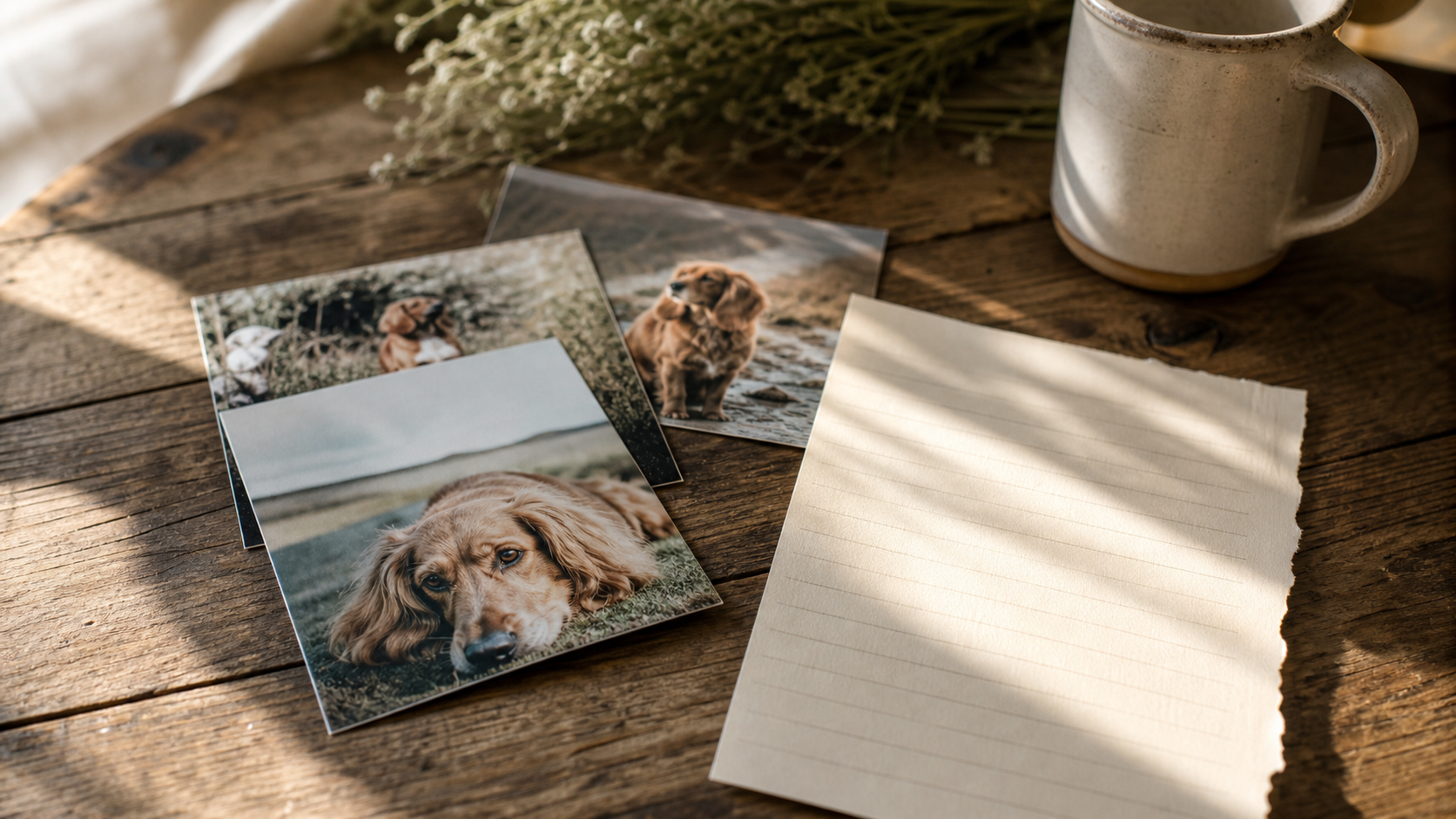
Some photographs matter because almost nothing appears to be happening. A companion is simply there, in a familiar room, on an ordinary afternoon.
Some photographs matter because almost nothing appears to be happening. A companion is standing in a doorway, lying beside a chair, or looking toward something beyond the edge of the frame. There is no occasion to name, no ribbon or gathering, no particular reason the camera came out. Perhaps the light fell across a familiar face. Perhaps an ear had folded in an especially characteristic way. The picture belongs to an ordinary afternoon, and that ordinariness is part of what makes it yours. Looking at it, you might wonder: what was happening just before this moment? What made you notice? The photograph holds one small piece of the day; your memory may hold the sound of the room, the weather at the window, or the conversation that continued afterward.
The background often has its own quiet contribution. Behind the face you meant to photograph, there may be a half-finished cup of tea, a stack of mail, a blanket slipping from the sofa. These things were probably not chosen for the picture. They were simply there, sharing the room. Later, they can become part of the story: that was the old kitchen, that was the chair beside the window, that was the blanket everyone somehow called theirs. A pet’s firm belief that the largest share of a sofa belongs to the smallest occupant may also be visible in the evidence. What details tell you where you were in your life? Which ordinary object, barely noticeable at first, carries a whole scene when you look again?
A photograph cannot include everything you knew about the moment. It offers the curve of a back, the angle of a head, the outline of paws against a rug, but not necessarily the familiar sound that accompanied them. There may have been a soft shuffle across the floor or the little click of claws, a rustle, a sigh. You might remember the pause before settling down, or the way a companion’s presence made a particular corner of the room unmistakably theirs. What belongs just outside this frame? What would someone need to know to understand why this unremarkable picture matters to you? There is room in the story for those missing details, including the ones you can only describe approximately: a sound like this, a movement almost like that.
For someone remembering a companion who has died, an everyday photograph may belong to a day that never seemed likely to become a keepsake. It was simply Tuesday, or a morning whose date you no longer remember. For someone sharing life with a companion now, a similarly ordinary picture may show a familiar expression you have seen a hundred times and still cannot quite put into words. Neither photograph needs to stand for an entire life. It can be one moment among many: the head turned toward the window, the patch of sunlight on the floor, the two of you in the same room. What do you recognize immediately? What remains uncertain? A photograph and a recollection do not have to answer every question to hold something particular.
There are also moments with no photograph at all. The camera was elsewhere, your hands were occupied, or nothing in the scene announced itself as worth recording. Perhaps you remember a companion appearing beside you while you sorted laundry, or the familiar shape of them at the far end of a hallway. Perhaps the memory is less a scene than a detail: one white whisker, a darker patch of fur, the weight of a shared afternoon. What small moment would you describe if there were no image to point to? Which words seem closest to its texture? A few sentences might contain the setting, an ordinary action, and the detail that makes it unmistakably this companion rather than any other. The absence of a picture leaves space for your own description.
Even among the photographs you have, the most significant one may not be the sharpest or the most carefully composed. There might be a blurred tail, a thumb at the edge, a face turned away at the exact wrong second. You know what you were trying to catch, and perhaps you know something else the picture caught instead: the room as it really looked, the distance between two chairs, the everyday company of being there together. Which photograph feels most like an ordinary day you shared? What would its caption say if it did not need to explain anything to anyone else? It might be no more than a place, a remembered sound, or a simple recognition: this was the afternoon light, and this was you beside me.
A place for their story
Remember a life, one link at a time.
Explore Paw & Memory at the address below, or scan the QR code to open the memorial starting point in your browser.
Explore memorials Scan or visitpawmemory.live/