
Paw & Memory Journal · family stories shared with permission
The Parts We Choose to Share
A companion’s place in family life can belong to many memories, each with its own storyteller and its own boundaries.
14 August 2026
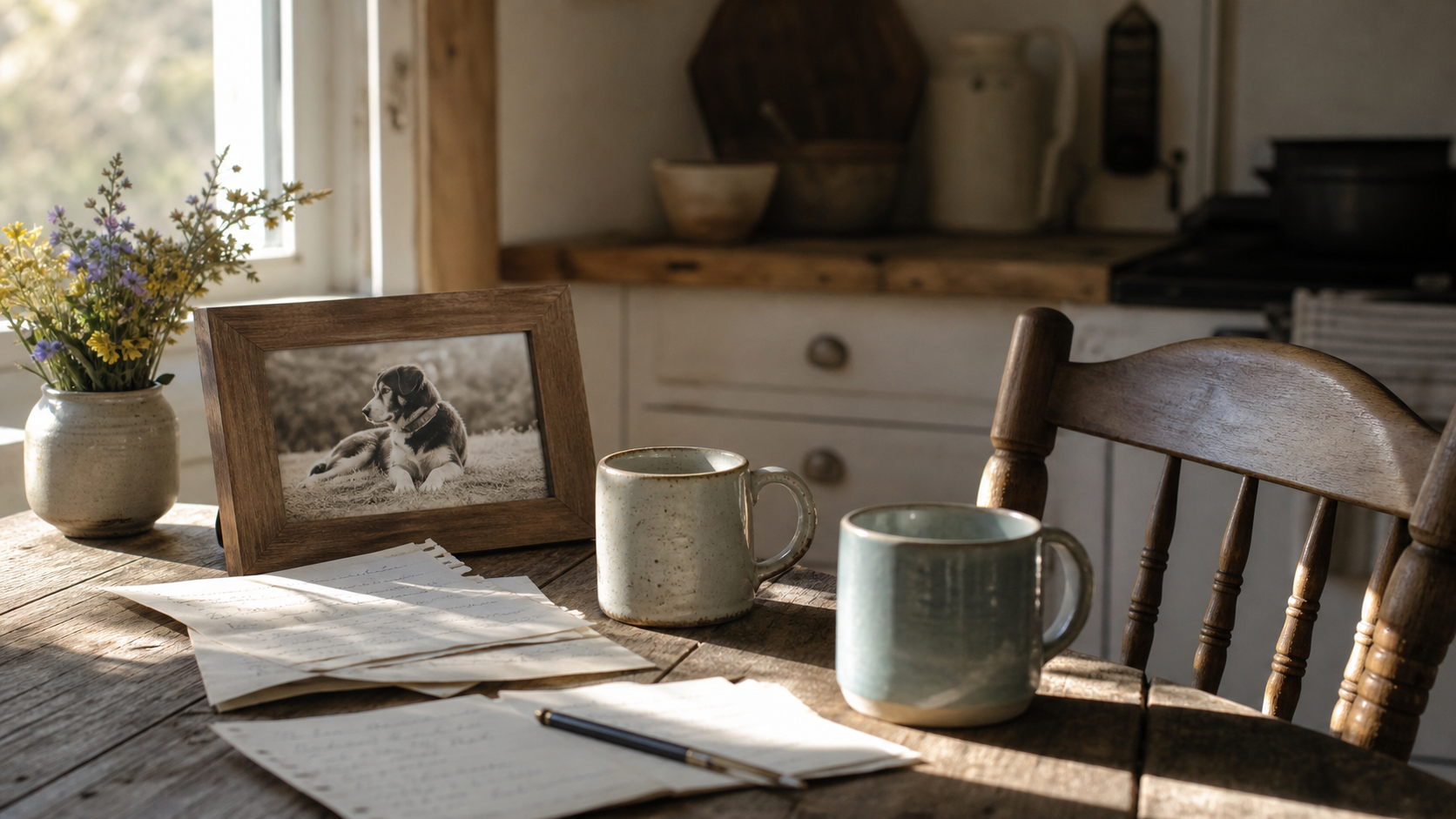
Sharing a family story can begin with a question: which part is mine to tell, and which part belongs to someone else?
A family story about a companion rarely belongs to just one voice. There is the person who remembers the afternoon clearly, the person who appears at the edge of the photograph, and the person who insists the weather was entirely different. At the center might be a dog under the kitchen table, a cat occupying the only chair anyone wanted, or a rabbit beside a familiar pair of slippers. Sharing that story can begin with a small question: which part is mine to tell, and which part belongs to someone else? Permission gives the other people in a memory room to answer. It also leaves room for a story to remain a family story, known around one particular table rather than introduced to every table in the world.
The everyday stories may be the ones with the most recognizable texture. Someone remembers the sound of a collar tag against a bowl; someone else remembers a patch of sunlight and the companion who seemed to consider it a reserved seat. A family member may have a photograph from an ordinary Sunday that another person has never seen. What does each person notice first: the animal, the expression on a familiar face, the old curtains in the background? Which detail feels comfortable to share, and which feels like a small possession of its own? There is gentle comedy in how a pet can become the unofficial chair of a family gathering without ever contributing to the minutes. That observation can belong to the whole room, while the conversation around it may not.
A photograph makes this question especially tangible. The companion may be the reason someone loves the image, but the frame can hold other lives too: a relative in pajamas, an unfinished birthday banner, a note on the refrigerator. For one person, it is a picture of a beloved face. For another, it is also a record of an afternoon they would rather keep close. What would the photograph’s people want others to know about that moment? Would they prefer the picture, the story without the picture, or neither? A remembered scene does not become less vivid because someone chooses not to share it. The striped cushion, the crooked banner, and the companion’s place between two knees can still have their place in the family’s own telling.
When a companion is being remembered after their death, people may return to different chapters. One person might want to tell the story of the first evening at home; another might treasure a much later afternoon when nothing remarkable happened. A third may not want their words repeated beyond the conversation in which they first offered them. What part of the companion’s life does each story bring into view? Whose voice is present in the telling, and whose voice has been left out? Permission may be quite specific: this photograph, but not that one; this funny sentence, but not the rest of the letter. There is room for those distinctions in a remembrance. A family does not have to agree on a single favorite memory for each memory to belong.
For a companion who is still part of the daily household, the stories may be unfinished in the nicest, most ordinary way. The window is still claimed each afternoon. The familiar blanket still appears in photographs. Someone is still discovering that the animal has become the main subject of pictures supposedly taken of a new bookshelf. Which recent moment would the family enjoy describing together? What words would each person choose for this companion’s everyday character? One might say dignified; another might remember an expression that looked distinctly unimpressed. Both can fit inside the same affectionate portrait. Sharing with permission also leaves space for a person to choose a smaller audience, or to offer their own version rather than have a sentence assembled for them by someone else.
Perhaps a shared family story is less like a finished portrait than a page with several kinds of handwriting. One person supplies the setting, another remembers the exact sound, and someone adds the detail everyone else missed. A crossed-out sentence can remain crossed out. An unnamed person can remain unnamed. What would feel right to preserve in words, and what would feel right simply to remember? Is there a phrase the family already uses that carries the companion into conversation—a reference to their favorite place, their particular expression, their excellent timing at the table? The story can end there, without explaining every person or every year. What remains on the page is the part its tellers chose to share: a glimpse of a companion, and a little of the life they shared.
A place for their story
Remember a life, one link at a time.
Explore Paw & Memory at the address below, or scan the QR code to open the memorial starting point in your browser.
Explore memorials Scan or visitpawmemory.live/