
Paw & Memory Journal · photographs and small moments
The Small Moments in the Frame
A reflection on the photographs that hold a companion’s everyday character, and the small moments that remain outside the frame.
26 June 2026
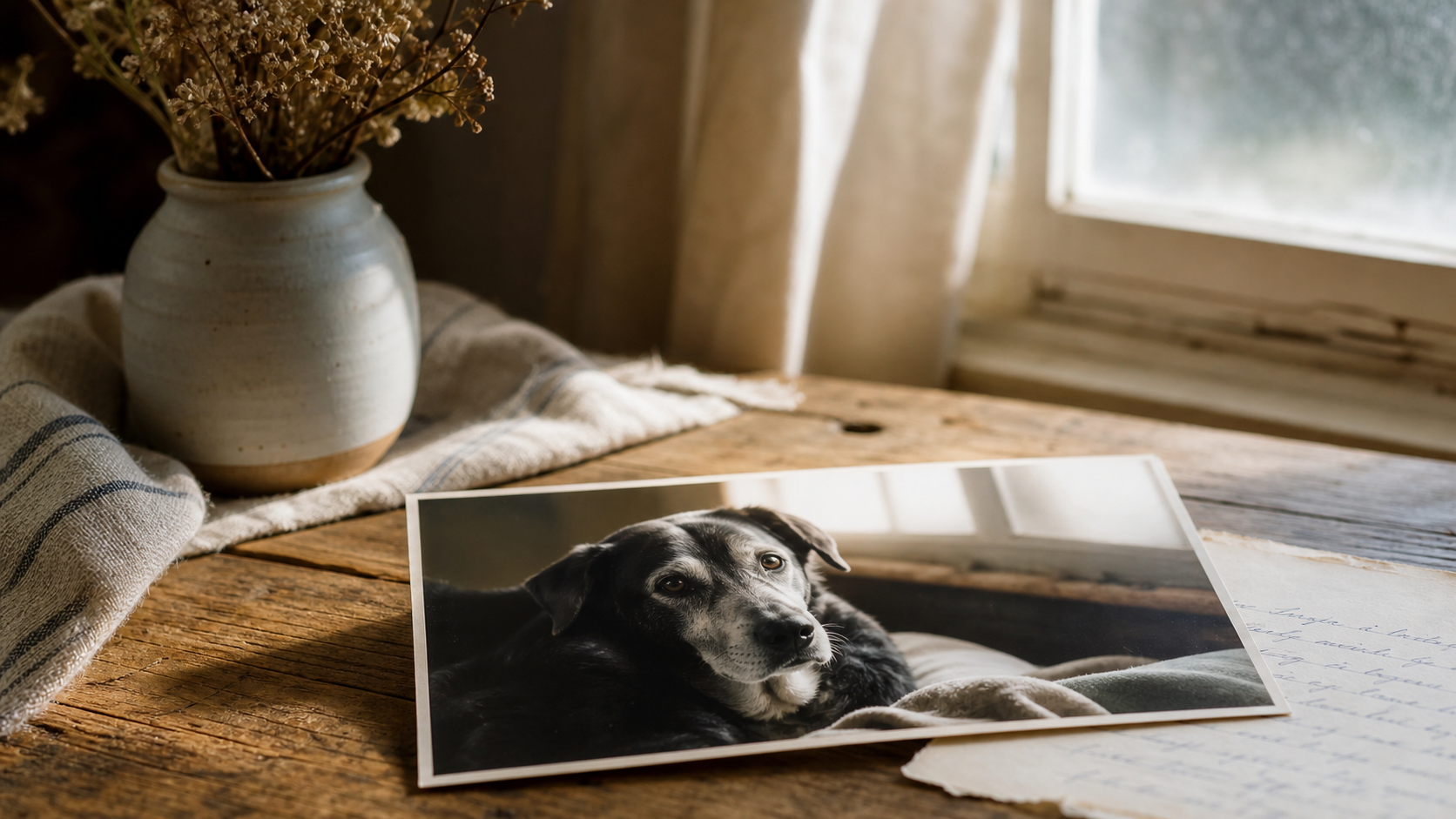
A photograph can hold the shape of an ordinary afternoon while leaving room for everything the camera could not catch.
Some photographs announce themselves as occasions: a birthday, a first afternoon together, a rare moment when everyone is looking in roughly the same direction. Others arrive without ceremony. A companion is half asleep beside a shoe. One ear appears at the bottom of a picture meant to show something else. There is a blur where a face should be, and behind it the familiar corner of a room. These pictures may not explain much to anyone outside the household. To someone who knows that ear, that corner, that particular arrangement of paws, they can contain a whole afternoon. What looks like an imperfect photograph may be an unusually precise record of being together, down to the untidy details that made the day yours.
The small moments often have their own scenery. There is the rectangle of light that crossed the floor, the chair with a coat thrown over its back, the doorway where a familiar face appeared. A photograph preserves these things without sorting them into important and unimportant. The laundry stays in the background. The chipped mug remains on the table. A companion occupies the exact middle of a cushion, with the air of someone who has been appointed chair of the household meeting. That little expression may be what you notice first; later, you might notice the room around it. Which background detail belongs most strongly to your shared days? A particular rug, an uneven stack of books, or the edge of your own sleeve might tell part of the story.
Photographs also leave things out. They cannot hold the sound that came before the shutter, the warmth of a familiar body nearby, or the pause between one ordinary thing and the next. A still image of a companion beside the kitchen door does not explain what you were making, what music was playing, or whether the afternoon had already become evening before you noticed. Yet those missing pieces can be part of the photograph’s meaning. The image offers a few visible details, and your own recollection supplies some of the rest. What happened just outside the frame? Perhaps there was a conversation, a dropped pencil, or nothing more eventful than someone turning a page. A moment does not need a plot to have belonged to you.
For someone remembering a companion who has died, an ordinary photograph may hold an especially particular kind of recognition: there you are, exactly as you were on a day neither of us knew would matter this way. For someone sharing life with a companion now, the same kind of picture may simply say: this is what Tuesday looks like in our home. Neither reading needs to be larger or more solemn than the other. There is room for affection, sadness, amusement, and the plain observation that a familiar face was caught in familiar light. A picture can be meaningful without being a favorite. Sometimes it is the awkward angle, or the unremarkable date, that makes it unmistakably part of your own life together rather than a portrait that could belong to anyone.
Not every remembered moment has a photograph attached. There may be an afternoon you can describe quite clearly but cannot find in any album: the position of a head beside your knee, a shadow across the hallway, a companion watching while you searched for something already in your hand. There may also be pictures whose circumstances have slipped away. You know the face but not the day. You recognize the place but cannot remember why you were there. Both kinds of memory leave room for a few words. If a photograph had a caption meant only for you, what would it say beyond a name and a date? Perhaps the words would be simple: the blue chair, the late light, the afternoon we did very little.
A collection of photographs need not add up to a complete account of a companion. It may show one side of a face more often than the other, one room more often than the rest, one season in much greater detail. Your shared story is wider than that collection, with whole stretches that passed without a camera nearby. Still, there is something lovely about the modest evidence photographs offer: you were here; the light fell like this; our lives met in this ordinary room. Looking at an image now, what small detail feels most like them? It might be a tilted head or the way they fitted beside you. The answer need not explain everything. It can remain as specific and unassuming as the moment itself.
A place for their story
Remember a life, one link at a time.
Explore Paw & Memory at the address below, or scan the QR code to open the memorial starting point in your browser.
Explore memorials Scan or visitpawmemory.live/