
Paw & Memory Journal · family stories shared with permission
The Stories We Choose to Share
A companion’s story often belongs to more than one person. Reflective questions about permission, differing memories, and the small details a family may choose to share.
8 July 2026
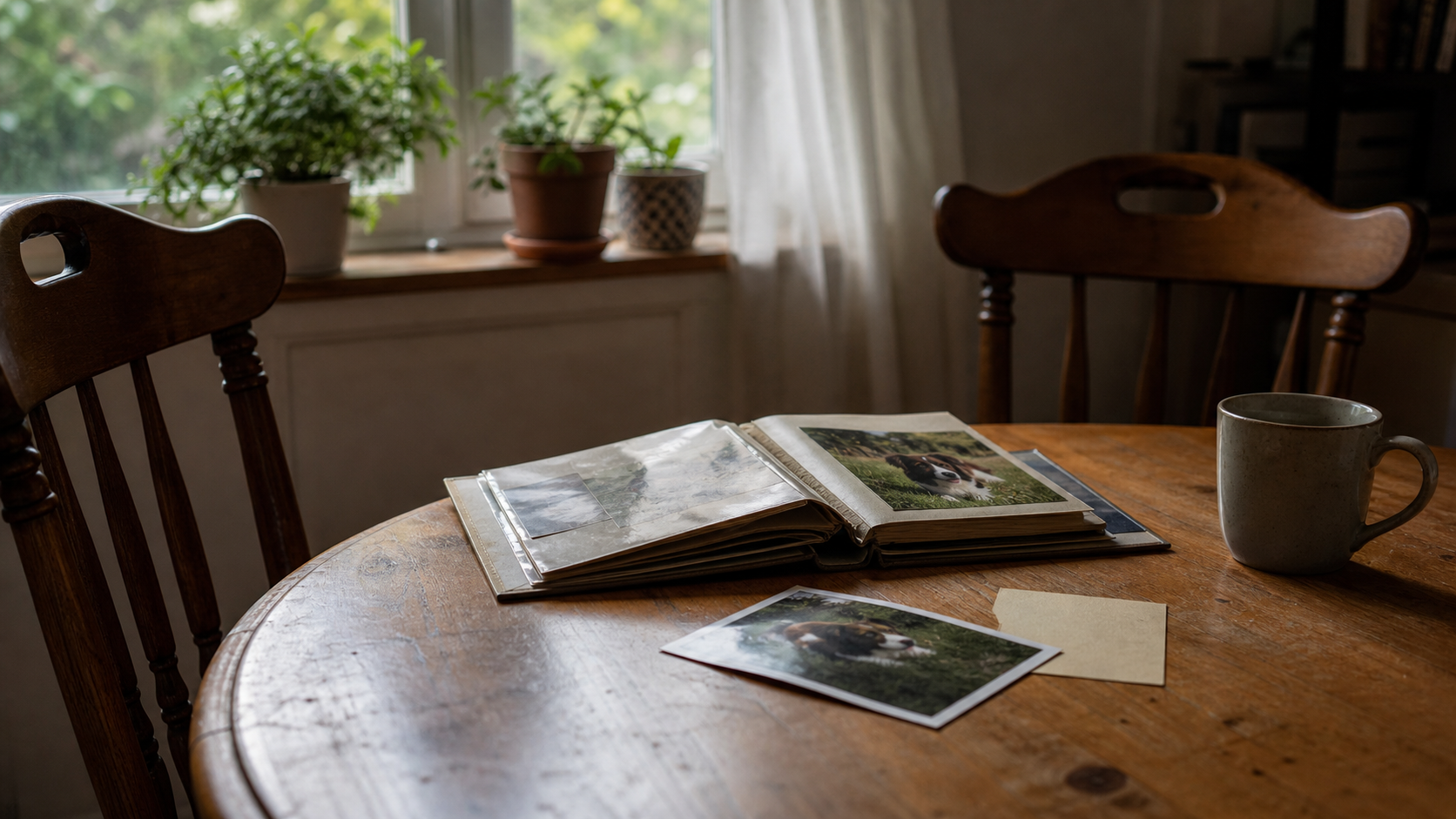
One person remembers the paws beneath the kitchen table; another remembers the face at the window. Family stories can hold both versions, along with a little room for the person who would rather keep a memory close.
A family story about a companion rarely has just one owner. There is the person who remembers the paws beneath the kitchen table, the person who took the photograph, and the person standing outside its frame. Each may carry a slightly different afternoon. Sharing with permission leaves room for those differences, including the wish to keep something close. Which parts of a story feel like yours to tell, and which parts seem to belong to someone else as well? Perhaps the most interesting detail is not the grand occasion but a familiar sound: a collar at the doorway, a sigh beside a chair, the quiet pause before someone said the animal’s name. Permission can be part of the story itself, rather than a formal word hovering above it.
A person might enjoy having their memory read around the table but not want it included in a wider family journal. Another might be happy to share the words but prefer their name left out. These are different ways of being present. What does a willing yes sound like in your family, and what room is there for a no, a not yet, or only this part? When you imagine a particular memory reaching another reader, whose voice do you hear in it? The answer may include someone who appears only briefly, holding a lead or opening a door. Photographs add their own questions. A picture may show a companion in a square of afternoon sun, while its edges hold a person’s bare feet, an untidy shelf, or a letter on the table.
The animal may be the reason for keeping it, but the frame contains more than the animal. What would the people in that picture want remembered, and what might they prefer not to have described? Even the caption can carry another person’s words or a family nickname. Which details feel welcome in a shared account? There can be a whole story in the patch of sun, without explaining every object or every person who happened to be nearby that day. Not every family member remembers a companion in the same way. One may recall a reserved presence; another, an eager participant in every household gathering. Neither memory has to become the official portrait. What scenes sit behind those different descriptions?
Perhaps there was a quiet morning window and a very social evening sofa. Perhaps the companion had a firm belief that any empty chair was simply a chair awaiting its rightful occupant. A shared journal can hold these small contrasts without settling them. Whose account brings forward a detail you had forgotten? What happens to the story when the familiar animal is seen from the other end of the room, through someone else’s fond attention? For a family remembering a companion, a story may arrive with a date attached, or with no clear date at all. For a family celebrating a companion’s everyday character, it may be yesterday’s ordinary moment, still fresh in everyone’s telling.
Both belong here. Permission concerns the people within these stories, whatever tense the memories take. Is there a scene someone has offered freely, in their own words? Is there another that remains theirs alone? A keepsake might carry the same distinction: the blanket is shared, but the account of who folded it last may not be. What part of its history feels ready for company, and what part still belongs to one person’s private recollection? A family journal need not account for every year or include every person’s favorite scene. It can be a modest gathering of stories that people have chosen to place together. Some entries may be long, some only a sentence beneath a photograph, and some spaces may remain empty.
What would make this particular collection feel like your family rather than an ideal version of one? Which ordinary moment would you be glad to find there years from now? The companion’s character might emerge through a dozen small details: the usual place, the familiar expression, the household phrase. Around those details are human voices, each with something to offer and a say in how that offering is shared.
A place for their story
Remember a life, one link at a time.
Explore Paw & Memory at the address below, or scan the QR code to open the memorial starting point in your browser.
Explore memorials Scan or visitpawmemory.live/