
Paw & Memory Journal · family stories shared with permission
The Stories We’re Glad to Share
A family’s pet stories often belong to more than one voice. Remembering who was there, and what each person is glad to share, can become part of the story itself.
2 September 2026
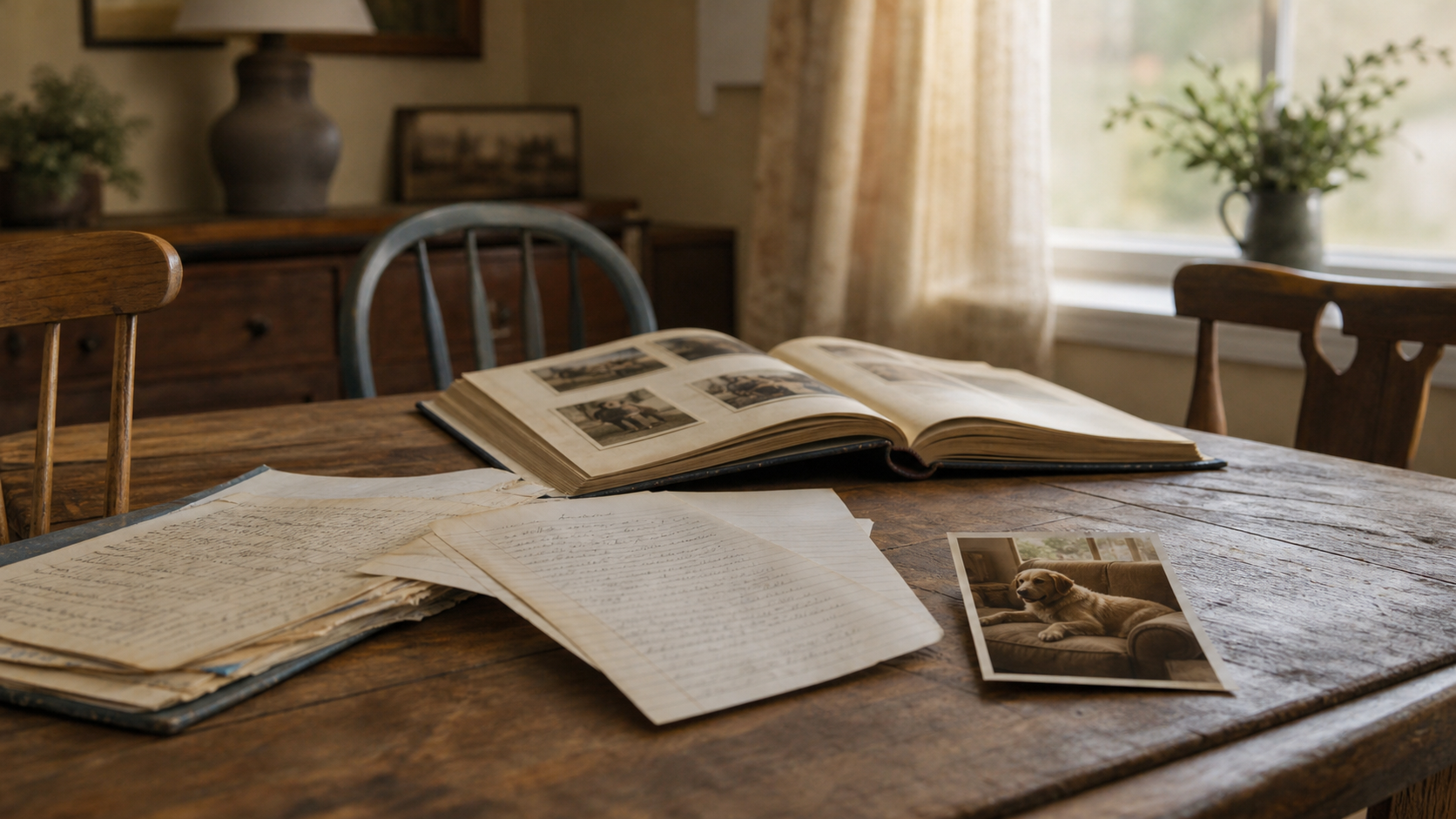
The same small moment can hold several family stories: the person who took the photograph, the person just outside its frame, and the companion who had already claimed the best chair. What feels welcome to share, and what belongs in a smaller circle?
A family story about a companion rarely has just one owner. There is the person who saw the moment, the person who tells it best, and the person who still laughs before the first sentence is finished. There may also be someone whose part feels too tender, or simply too personal, for a wider audience. Permission belongs in this picture, not as a grand speech but as room for each voice. A story can be loved without being told everywhere. When you think of a moment your family returns to, whose face appears beside your companion’s? What part feels like yours to tell, and what part might sound different in someone else’s words? Perhaps the story begins with a photograph of a cat in a laundry basket.
One person remembers the warm towels; another remembers searching for a missing sock; someone else remembers the chair just outside the frame. The picture holds one instant, while the family holds several versions. Even the cat’s expression might invite debate: dignified resident, accidental guest, or supervisor with serious doubts about the folding. No single caption has to carry all of that. Which detail would each person want included? Is there a phrase someone would rather keep within the family? The words around a photograph can reflect not only what happened, but whose account is welcome beside it. Permission may have a different meaning when a story moves from a kitchen table to a page other people will read.
Someone might love hearing a memory aloud yet feel less at home seeing their own words in print. Another person might be happy to share the pet’s antics but not the circumstances surrounding them. That difference need not make the memory smaller. It may leave the focus on a familiar paw resting across a foot, a nose at the window, or the sound of a name called from another room. What remains vivid when private details stay outside the frame? Does the story still feel full when it rests on one shared, ordinary moment? For someone remembering a companion, a family story may contain both a bright little scene and the ache of not seeing it happen again.
For someone whose companion is nearby, the same kind of scene may still be unfolding between sentences. Neither needs a tidy ending to belong on a page. A story about the good chair can remain a story about the good chair: who usually sat there, who found it occupied, and how much space a small animal somehow required. What tone feels true to everyone whose voice is present? Is this a memory your family meets with laughter, quiet, or a mixture that changes from one telling to the next? There can also be room for the person who does not want to contribute a story. A blank space beside a photograph need not mean a blank feeling.
Some family members have a whole tale ready; others offer a date, a nickname, or a single remembered detail. Someone might recall the tiny click of paws in the hall but have no wish to explain more. A shared page can hold different amounts of speech without making them seem equal in feeling. What would a family collection look like if each voice kept its own size? Whose brief phrase carries a whole scene for you, even though a reader outside the family might never know why? Perhaps the finished story is less polished than the first version you imagined. It has a gap where someone’s private moment would have been, two accounts of the same afternoon, and a caption that sounds unmistakably like the person who offered it.
Those edges can be part of its character. A family does not have to speak in one voice to remember one companion. The shared thread may be as small as an ear turned toward a familiar sound or a place at the table where everyone still looks. Which words feel gladly shared? Which belong in a smaller circle? And what does your companion’s everyday presence, past or present, look like when each person has room to tell their part? title
A place for their story
Remember a life, one link at a time.
Explore Paw & Memory at the address below, or scan the QR code to open the memorial starting point in your browser.
Explore memorials Scan or visitpawmemory.live/