
Paw & Memory Journal · family stories shared with permission
The Stories We Share, the Parts We Keep
A family’s pet stories can hold many voices. These reflections explore the little details we share, the memories we keep close, and the permission that gives each storyteller room to choose.
14 September 2026
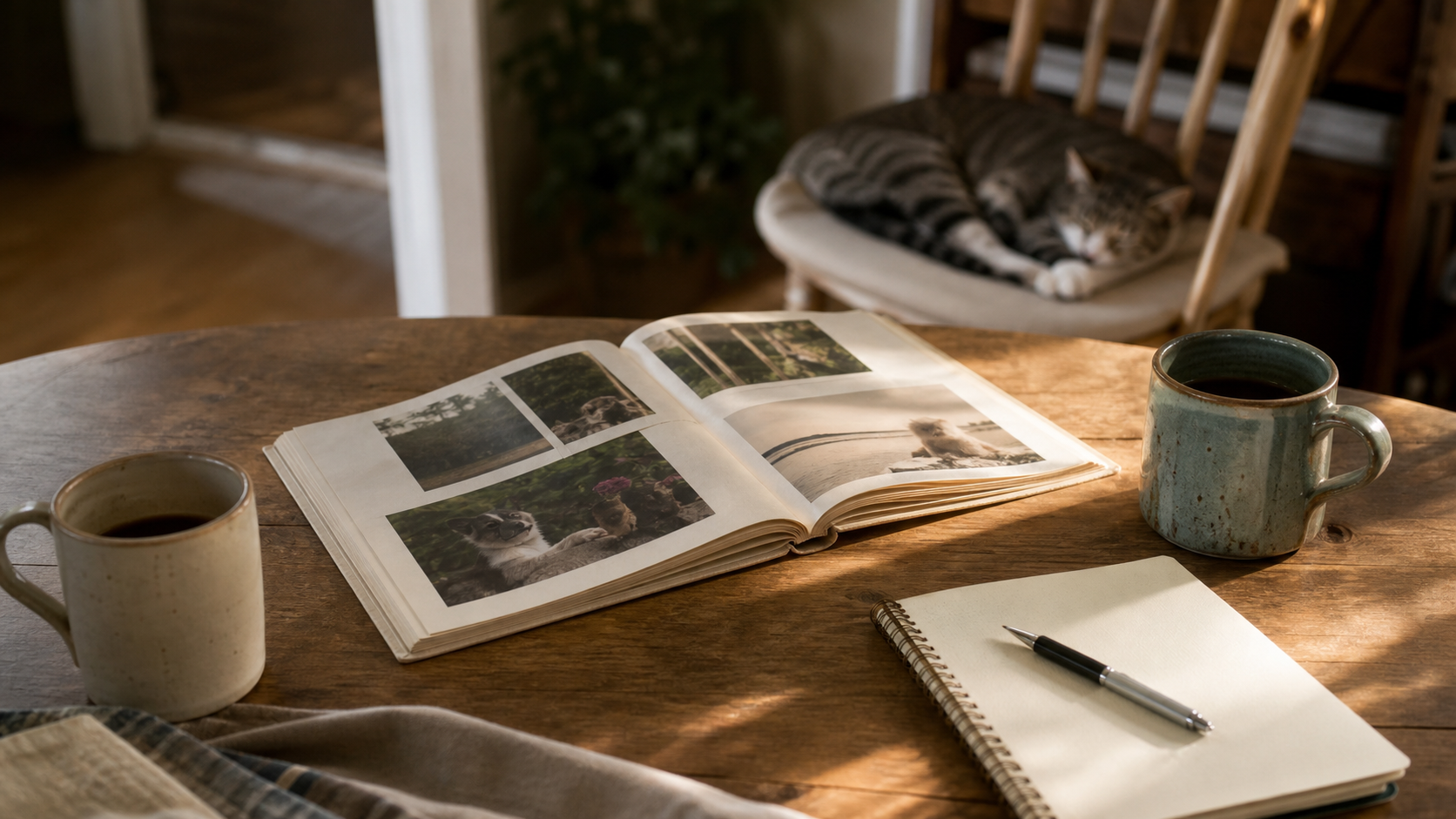
A photograph may belong to one person while its story touches several. Around a kitchen table, in a family message, or beside an old album, what feels right to share can be as personal as the memory itself.
A family story often starts with a small claim: that was my chair, my slipper, my side of the bed. Then someone else remembers it differently, and the animal at the heart of the tale seems to have belonged to every version at once. A cat in a patch of sun, a dog waiting beside a coat, a rabbit under the table: these details can become part of the language a household shares. Yet a shared memory is not quite the same as a story everyone wants told. Who first noticed the moment? Whose voice gives it its shape? What might change when a tale moves from the kitchen table to a wider circle? Permission can be a small, ordinary exchange, not a grand announcement.
Perhaps one person loves the photograph of a muddy paw beside a clean shoe, while another remembers the face just outside the frame and would rather leave that part untold. A yes to the picture may not be a yes to every story around it. There is room for affection without a full account, and room for someone to say that a detail feels like theirs. Which part of a family memory feels easy to share? Which part belongs to a quieter conversation? How might the story sound if each person could choose the piece they wanted to add, or leave out? Different tellings need not compete for the final word. In one person’s version, the dog’s great achievement might be carrying a sock through the house; in another, it might be the solemn pause before dropping it at someone’s feet.
One voice remembers the noise, another the look, another the time of day. The companion’s character appears in those small differences, as if each teller has kept a different photograph without using a camera. And perhaps the pet’s own contribution was mostly to acquire the best chair while everyone discussed the matter. What detail would each person put in the first sentence? What small disagreement could remain in the story simply because it belongs there? For someone remembering a companion who has died, a familiar anecdote may sit beside things that are harder to put into words. For someone living with a companion now, the same sort of story may arrive fresh each morning, attached to a creaking stair or the sound of a cupboard door.
Neither needs to become a polished tribute. A story can be a few lines about the place an animal chose to sit, or the way one family member always narrated their entrance. Which everyday scene comes back most clearly? Is there a phrase that still sounds like a particular person saying it? What would be missing if the telling became too neat? Photographs and keepsakes add another voice to the conversation. A worn collar in a drawer, a print with one corner bent, or a note on the back of a picture might bring different moments to mind for different people. The object does not explain itself; the family supplies the meaning, sometimes in fragments.
One person may remember who took the picture, while another recalls what happened just afterward. What does everyone agree is worth saying about it? Is there a caption that leaves space for more than one memory? What part of the scene can stay unnamed without making the story feel incomplete? Even a small blank can belong to the telling too. A family story shared with permission can still sound like a family: a little uneven, full of familiar turns of phrase, with someone remembering one more thing just when the telling seems finished. It need not include every person, every feeling, or every year. There may be a version for the album, a version for a friend, and a version that stays between the people who were there.
What would make a shared telling feel recognizably yours without speaking for everyone else? Whose words would you most like to hear beside your own? At the center might be nothing larger than a warm patch on the rug, and the companion who made it part of the family’s day.
A place for their story
Remember a life, one link at a time.
Explore Paw & Memory at the address below, or scan the QR code to open the memorial starting point in your browser.
Explore memorials Scan or visitpawmemory.live/