
Paw & Memory Journal · family stories shared with permission
The Stories We Share, the Stories We Keep
A companion’s life gathers many tellings. Some belong at the kitchen table, some travel farther, and some stay with the person who holds them. There is room for all three.
9 October 2026
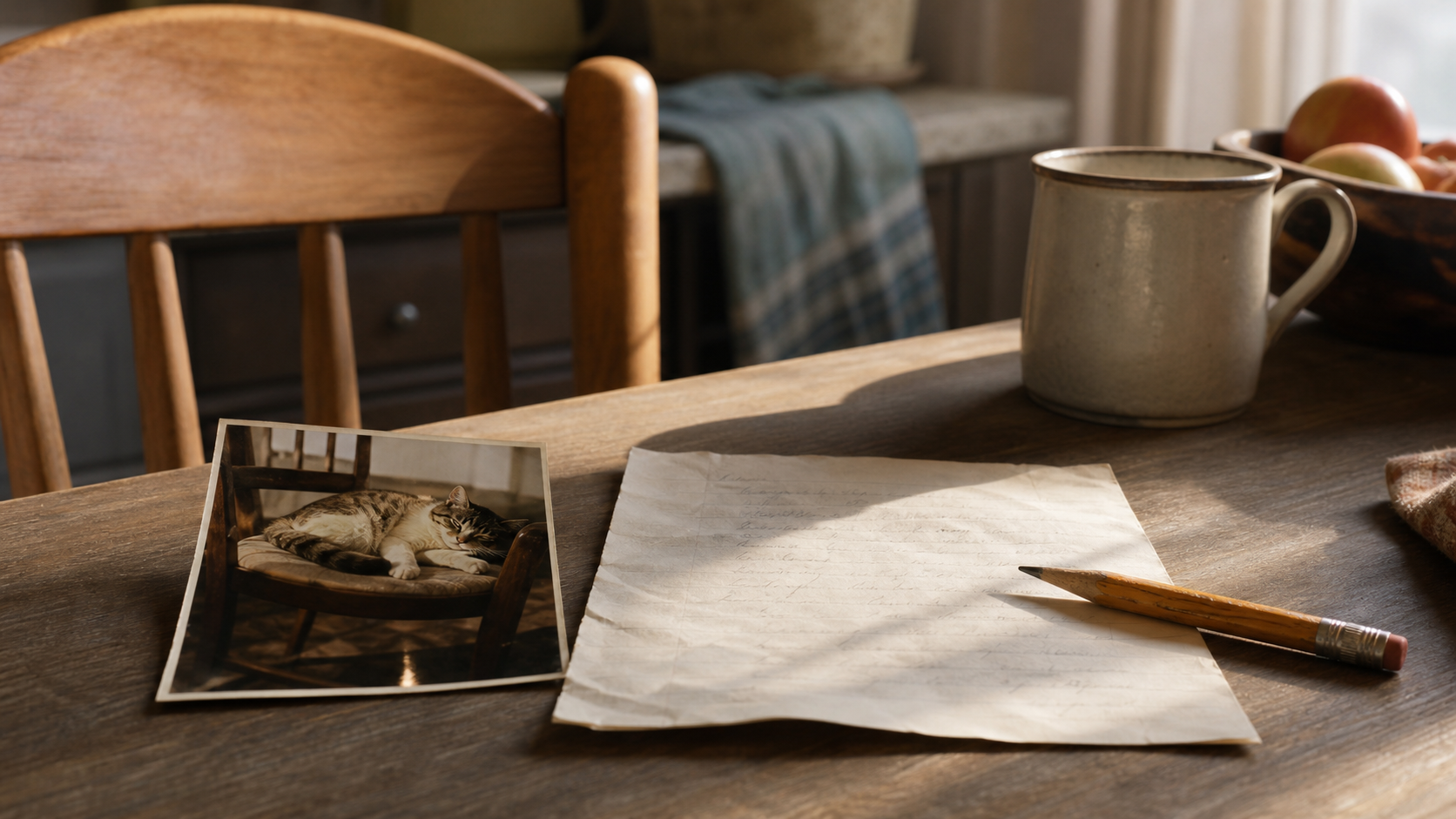
Family stories can hold a companion’s everyday character and the different ways each person knew them. Sharing with permission leaves room for affection, differing memories, and details that someone would rather keep close.
A family story often begins with a small detail: the worn patch on a chair, a nose at the edge of a photograph, the sound everyone remembers but describes in a different way. A companion can belong to a whole household without belonging to one shared version of the past. One person recalls the long afternoons; another remembers the brief hello at the door. When those stories travel beyond the kitchen table, permission becomes part of the telling. Not a grand ceremony, just room for the person whose memory it is. Which moment feels like yours to share, and which seems to carry someone else’s voice as much as your own? What would you want a reader to notice? Perhaps there is a photograph everyone likes for a different reason.
You love the soft fold of an ear. Someone else loves the old sofa behind it. A third person sees a day they would rather not explain. The picture may be familiar, while the feelings around it are less visible. A yes to sharing the photograph might not include every story connected to it. What does permission mean within this particular family memory: the image alone, a few words, a name, or the longer account? Is there a detail whose absence would leave the warmth intact? A story can still feel full when it does not contain everything, even when the people in it remember much more than the frame shows. The nicest family stories are not always the ones with a clear ending.
They may be about an ordinary Tuesday, with a bag on the floor and a companion settled where someone intended to sit. Perhaps the cat attended every family meeting without ever approving the minutes. Beneath that small joke is a recognizable scene: people gathered, a familiar presence among them, the day going on. For a companion here now, such a scene may be part of today’s household life. For a companion being remembered, it may be one of the moments that comes back most clearly. Which ordinary scene would each person choose? Would the same chair appear in every telling, or would each memory lead somewhere else? Permission can have a particular shape rather than a broad one. A person may be glad to share a story among relatives and feel differently about seeing it in a journal.
They may welcome their words but not their name, or the whole scene except for one private detail. Those differences can belong to the story without becoming its subject. The affection does not depend on a wide audience. Who was the first intended listener for this memory? Does it feel different when imagined on a page rather than spoken over tea? What part of the moment matters most to the person who remembers it, and what part matters most to you? Sometimes those answers sit comfortably beside each other; sometimes they remain distinct. Families may remember the same companion in ways that do not quite match. The dog who seemed quiet to one person may fill another person’s stories with sound.
One remembers a favorite corner; another remembers movement from room to room. Neither account has to become the official portrait. A shared journal can hold the differences as differences, with each voice still recognizable. What words sound unmistakably like the person who first told the story? Which details come from your own memory, and which were given to you by someone else? For a companion being celebrated or remembered, there may be something lovely in that unfinished picture: several people looking toward the same life, each from the place where they stood. Some stories remain inside a family, and some remain with just one person. That does not make them less meaningful than the ones written down. An untold memory may still live in a glance toward a doorway, a photograph kept between pages, or a phrase that needs no explanation at home.
A story shared with permission carries more than an account of a companion; it carries something of the people who knew them, too. What would you like those people to recognize in the telling? What would you hope remains theirs? The page need not claim the whole life. It can hold one welcomed moment: a familiar face, a small scene, and the voices that have agreed to meet there.
A place for their story
Remember a life, one link at a time.
Explore Paw & Memory at the address below, or scan the QR code to open the memorial starting point in your browser.
Explore memorials Scan or visitpawmemory.live/