
Paw & Memory Journal · welcoming a new chapter while holding an old story
Welcoming a New Chapter While Holding an Old Story
There can be room for what is beginning and what remains part of the family story.
2 October 2026
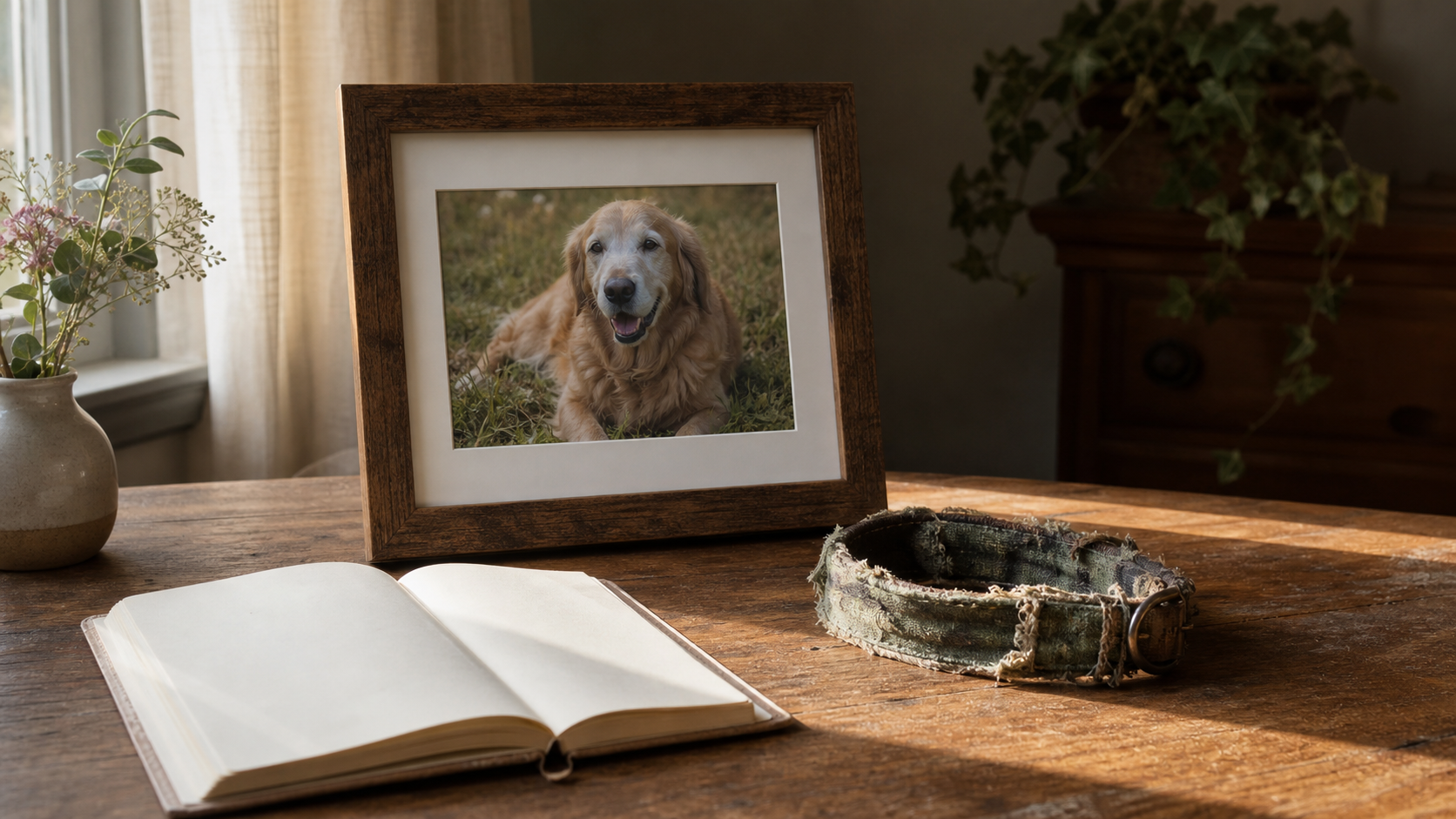
A new chapter does not have to arrive with an empty shelf. Sometimes it begins beside a photograph, a familiar name, or an ordinary afternoon worth remembering.
A new chapter rarely announces itself as neatly as it does in a book. There may be no clean page, no satisfying turn, no sentence that explains exactly where the old part ends. Instead, there is a different set of keys on the table, a cardboard box beside the sofa, or a companion whose familiar face has acquired a few more silver hairs. There may be a new animal in the household, or simply a new season in the life already being shared. Meanwhile, an older story remains present in a photograph, a nickname, the particular way someone says, “Remember when?” Beginning and remembering can occupy the same room without either one having to explain its presence to the other.
The older story is often made of wonderfully unimportant things. A dog standing in the background of every birthday photograph. A cat occupying the exact patch of newspaper somebody was reading. The small sound of a collar that became part of the household’s ordinary music. For someone remembering a companion who has died, these details may be what comes to mind before any grand occasion. For someone whose companion is nearby, they may still be happening between the larger events of the day. What ordinary moment would belong in the story if nobody were trying to make it impressive? Perhaps the answer is a crooked ear, a habitual seat, or the solemn expression of an animal who appears to believe every parcel has arrived specifically for them.
Photographs hold their own versions of these stories. One image might show a younger face, an earlier home, a chair that has since disappeared. Another might be blurred because the subject had more pressing interests than remaining still. The photograph chosen for a frame is not always the one that says the most; sometimes the revealing detail lives at the edge, where a paw rests against a shoe or a person’s hand appears without the rest of them. Looking across pictures from different chapters, what stays recognizable, and what has changed? The question can belong equally to the animal and the family. There is room in an album for the beautiful portrait and the badly lit kitchen scene that somehow contains an entire Saturday.
A new companion, when there is one, brings a story that has not yet gathered its familiar phrases. Their place in the household may still feel unnamed, while the remembered companion’s place seems full of precise details. Those stories need not match. One might be associated with muddy photographs and exuberant greetings; another with windowsills and an expression of permanent editorial judgment. Affection does not require identical characters, identical moments, or identical words. What feels distinctly theirs already? What memory belongs unmistakably to the companion being remembered? Even similar gestures can carry different meanings in different stories. The same sunny square on the floor can appear in photographs years apart, with two entirely different occupants and two entirely different afternoons around them.
Keepsakes can make the overlap visible: a worn tag in a drawer, a blanket folded on a shelf, a handwritten name on the back of a photograph. Their significance may be plain to one person and invisible to another. The chipped bowl in a picture might look like background scenery until someone remembers the kitchen it stood in, the conversations nearby, the companion who belonged to that scene. A newer object may sit beside an older one without becoming its replacement. Which object carries a whole story in miniature? Which small detail from the present might someday do the same? These questions leave space for mixed answers, including the quiet possibility that a beloved memory has no object attached to it at all.
Welcoming a new chapter while holding an old story can look less like a turning point and more like an ordinary evening. Someone mentions a remembered name. A companion currently sharing the household stretches across the rug. A photograph catches the last of the light. The old story does not have to become a lesson, and the new one does not have to prove that anything has been resolved. Each can retain its unfinished sentences, its funny details, its private importance. What would a page about this particular evening contain? Perhaps very little happens on it. Perhaps that is precisely what makes it worth keeping: not a declaration about moving forward, but the record of a life in which what came before and what is here now both belong.
A place for their story
Remember a life, one link at a time.
Explore Paw & Memory at the address below, or scan the QR code to open the memorial starting point in your browser.
Explore memorials Scan or visitpawmemory.live/