
Paw & Memory Journal · Behavior, Training & Enrichment
Rescue Adoption Beyond the 3-3-3 Rule
The familiar 3-3-3 idea offers a starting point for reflecting on rescue adoption. Its broader subject is the meaning of homecoming, the limits of a timeline, and the space between expectation and relationship.
27 March 2026

Rescue adoption is often discussed through the shorthand of the 3-3-3 rule. A closer reading shifts attention away from a countdown and toward a more open question: what does it mean to welcome an animal without turning the relationship into a set of milestones?
Rescue adoption brings the idea of home into focus. In public writing about adoption, homecoming is often presented as both an arrival and the beginning of a relationship. The familiar 3-3-3 rule belongs to that conversation, offering a numerical shorthand for the subject of settling in. Its appeal as a piece of language is easy to understand: a complicated topic fits into a phrase that is simple to remember. Yet a memorable phrase and an account of an individual animal are different things. This distinction leaves room for a warmer discussion of adoption, one that does not depend on a promised turning point.
The central tension in the 3-3-3 idea is between a calendar and a relationship. A calendar divides time into clearly marked units; a relationship is not itself a unit of time. Read as a general framework rather than a timetable, the phrase raises questions about the expectations attached to adoption. Words such as settled, familiar, and at home carry meanings that extend beyond a date. They can describe an aspiration in adoption writing without establishing an outcome for any particular dog. The numbers are therefore part of the conversation, not a complete account of what homecoming means.
Another theme in discussions of rescue adoption is the distinction between an animal’s recorded history and the story people attach to it. A description of the past is not the same as a script for the future. Nor does the label rescue supply a complete biography. Public education can acknowledge that distinction without inventing a difficult past, a triumphant transformation, or a moment when everything falls into place. There is something respectful in leaving those narrative gaps unfilled. It allows adoption to remain a subject of care and curiosity rather than a ready-made story with an expected ending.
Seen in this light, the 3-3-3 rule is most interesting as a way into a broader reflection on welcome. The subject is not how to produce a particular response, but how expectations are expressed when an animal becomes part of a household. Individual questions belong with a qualified veterinary professional; a general article has a different role. It can examine the language of milestones, belonging, and patience without converting those ideas into instructions. Rescue adoption remains the heart of this discussion, with home understood not as a deadline to meet but as the setting for a relationship whose meaning is larger than a countdown.
Continue reading
Related articles.

Behavior, Training & Enrichment · 8 May 2026
Cats, Tabletop Objects, and the Stories We Tell
A cat batting something from a table sits at the meeting point of feline curiosity and human expectations. The familiar question opens a wider conversation about play, attention, and the meanings people give to everyday behaviour.
Read this article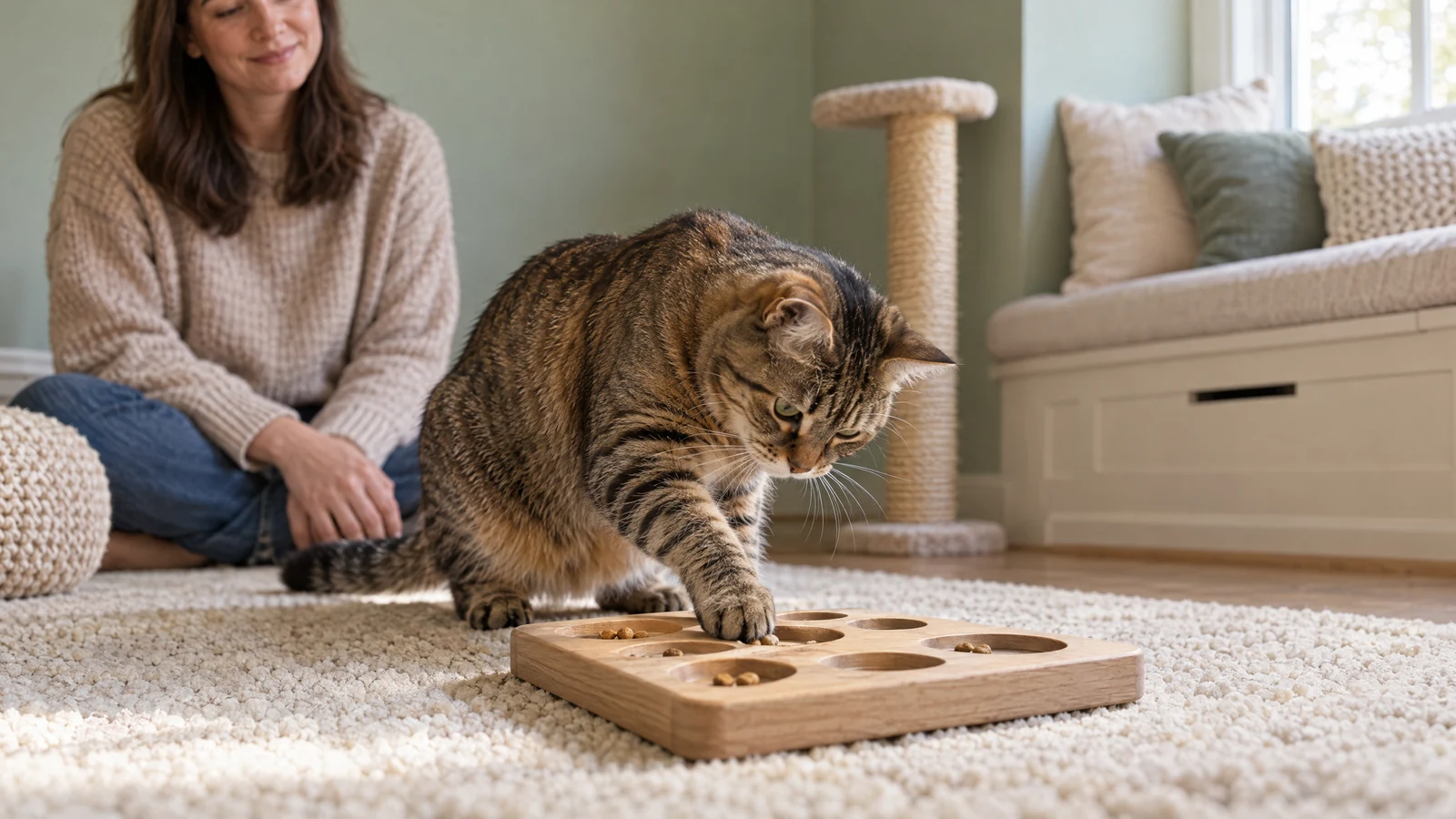
Behavior, Training & Enrichment · 6 May 2026
Cat Puzzle Toys and the Meaning of Play
A reflective look at cat puzzle toys, the language surrounding them, and the place of a single object within the larger idea of an indoor home.
Read this article
Behavior, Training & Enrichment · 4 May 2026
Litter Boxes and the Shared Geography of a Multi-Cat Home
A reflection on litter boxes as part of shared domestic space, where questions of number sit alongside the quieter subjects of location, privacy, and individuality.
Read this articleA place for their story
Remember a life, one link at a time.
Explore Paw & Memory at the address below, or scan the QR code to open the memorial starting point in your browser.
Explore memorials Scan or visitpawmemory.live/