
Paw & Memory Journal · letters and the words we keep
Letters and the Words We Keep
A letter can hold a greeting, a small household detail, or something that was hard to say aloud. The words we keep make room for both remembrance and the daily pleasure of knowing a companion.
24 October 2026
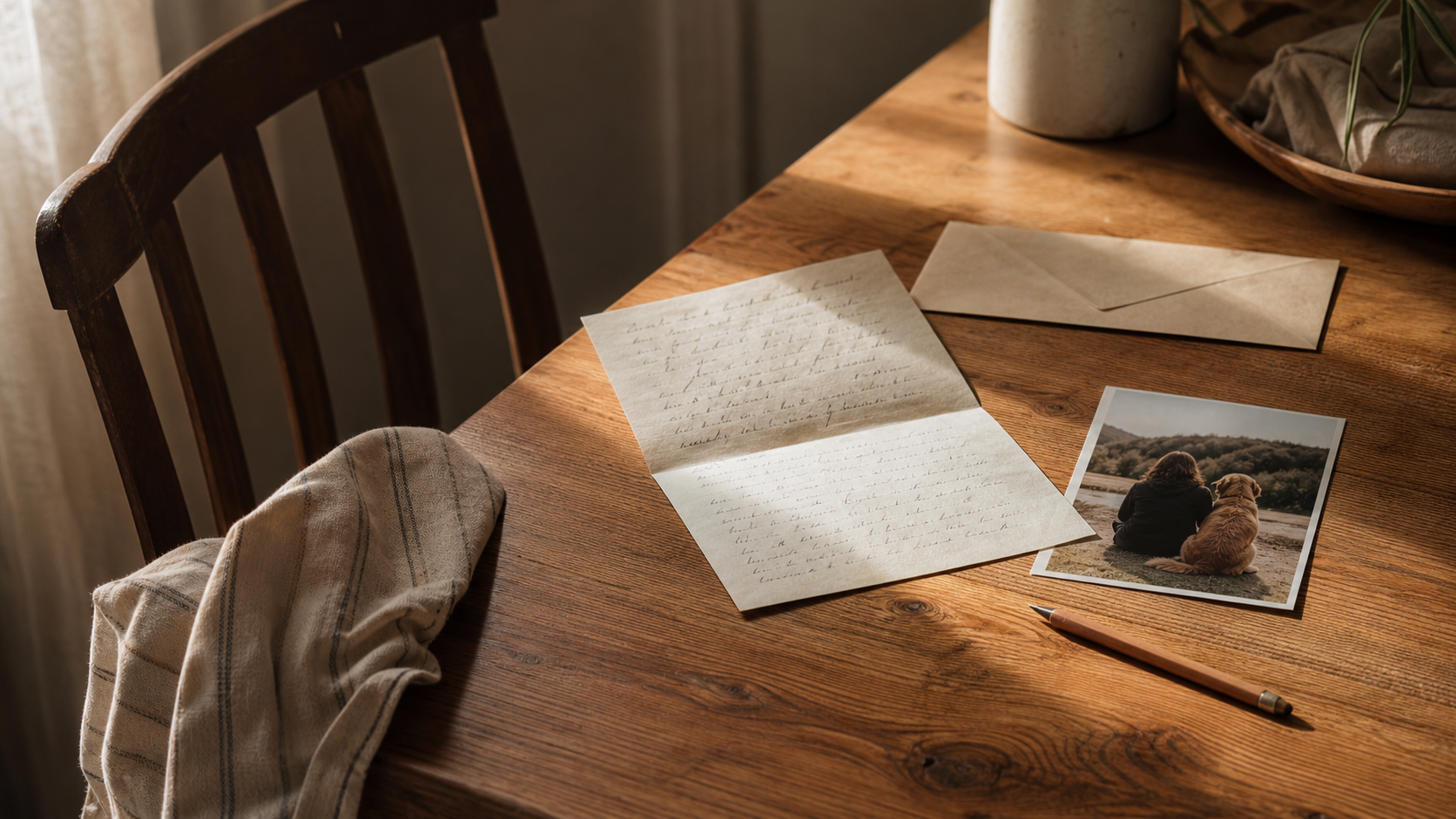
Some letters begin with a name. Others begin with the thing that happened this morning. Whether written beside a sleeping companion or after a goodbye, they can hold the ordinary details that make a relationship feel like no other.
Some letters begin with a name. Others begin with the thing that happened this morning: the rain at the window, the chair left empty for three seconds, the familiar weight settling beside a knee. A letter to a companion need not sound grand to feel exact. It might say, “You were here while I made the tea,” and mean something that a longer account could miss. There is room in such writing for a dog still asleep nearby, a cat watching from the sill, or an animal whose presence is now remembered. The page does not have to choose between an ordinary day and a day that matters. Sometimes they are the same day.
The words we keep are not always letters in envelopes. They may be a line on the back of a photograph, a message sent across town, or a scrap bearing a nickname that makes sense only within one household. “Your side of the sofa” can be an address as precise as any street. A note about a walk may mention the weather and leave out almost everything else, yet still bring back the sound of feet at the door. These small pieces of language carry the scale of life together: not a complete history, but one close view. They show what caught someone’s attention before anyone knew it would become a detail worth returning to.
Writing directly to a companion has a particular intimacy. The usual explanations can fall away. There is no need to describe which bowl, which window, which patch of sun; the writer already knows the place being named. “You waited by the blue chair” has its own quiet certainty. So does, “You always came to inspect my shoes, as if I had attended an important meeting without you.” A letter can leave that small absurdity intact, without making it a lesson or a symbol. Character lives in particulars. The slow arrival, the sideways glance, the determined choice of the least convenient seat: each belongs to a relationship rather than to an idea of what an animal ought to be.
After a goodbye, a letter may have a different shape. It can circle a moment, stop halfway through an account, or say very little. Affection and sorrow do not always arrive in neat sentences, and not every page needs a conclusion. One person may write about the last photograph; another may find themselves describing an afternoon from years earlier, when nothing unusual happened at all. Neither version has to stand for the whole life. A remembered companion had many days, and the person remembering them has many ways of meeting those days again. Even a plain sentence about where they liked to sit can hold both the pleasure of knowing them and the ache of their absence.
For a companion who is still sharing the days, letters can belong to the present tense. “Today you sat beside me while I folded the washing.” “This evening the light reached your paws.” Such lines need no occasion beyond the fact that someone noticed. A page might catch a season of life that otherwise feels too familiar to describe: the usual route through a room, the pause before settling down, the sound that means someone has arrived. Celebration can be quiet. It can look like a date above a few sentences, written while the household carries on around the writer. There is no requirement for the moment to be exceptional before it has a place in words.
The language of a household is often modest: greetings at the door, names called from another room, phrases repeated without much thought. On paper, those words can reveal how much company they held. A letter may preserve the way someone spoke to their companion rather than a polished account of the companion’s life. It may include a crossed-out word, an uneven line, or a sentence that sounds exactly like its writer. Beside a photograph or tucked among other papers, it remains a particular expression of affection, not the final version of a relationship. There is room for another letter, another remembered detail, or simply the old greeting, written once more in the voice that used to say it.
Continue reading
Related articles.
letters and the words we keep · 28 September 2026
Letters and the Words We Keep
Some letters are addressed to a companion. Others are written around them, in the margins of ordinary days. A reflection on familiar phrases, unfinished sentences, and the small details we choose to keep.
Read this article
letters and the words we keep · 16 September 2026
Letters and the Words We Keep
Some letters are addressed to a companion. Others are tucked into the language of an ordinary day. A reflection on the nicknames, small stories and familiar phrases that hold a place in a pet family’s life.
Read this article
letters and the words we keep · 28 August 2026
Letters and the Words We Keep
The nicknames, small stories and unfinished sentences that belong to life with a companion.
Read this articleA place for their story
Remember a life, one link at a time.
Explore Paw & Memory at the address below, or scan the QR code to open the memorial starting point in your browser.
Explore memorials Scan or visitpawmemory.live/